The Short Edit
Souvenirs Worth the Suitcase: A Coffee-Table Edit
Ten categorical souvenir registers — ceramics, incense, tea, lacquer, paper — read at the Cheongdam standard and packed for the long flight home.
One arrives in Gangnam expecting to be sold something loud, and the better souvenir conversations — and this matters — refuse the volume. The objects worth carrying back to a Causeway Bay flat or a Lee Garden Three lounge are not the airport-duty-free legibilities; they are the quieter registers a careful eye finds in the side streets off Apgujeong-ro, the ateliers behind the Sinsa florists, the curated shelves of the Galleria's craft floor. What follows is a categorical edit of ten souvenir registers — ceramics, incense, tea, lacquer, paper, and the adjacencies — read at the standard the older Cheongdam vitrines hold themselves to. 慢慢揀, as the Cantonese phrasing has it; the coffee table is a long commitment, and the suitcase is shorter than the trip.
How this edit was assembled — methodology and editorial constraints
The ten registers below were drawn from three sources of evidence and from a deliberately narrow editorial frame. The first source: the curated shelves of the Galleria's and Shinsegae's craft and home floors, where the buyer's editorial discipline reads at the standard the better Hong Kong department stores — Lane Crawford's home floor, Joyce's craft window — would recognise. The second source: the smaller ateliers and craft showrooms in the corridor between Apgujeong-ro and Dosan-daero, where the maker is named, the kiln is identified, and the provenance is articulated in the shopkeeper's first paragraph. The third source: the Korea Craft and Design Foundation's published register of master craftspeople, which sits behind the better Gangnam editorial buyers' selections and reads as the connoisseur's quiet reference. The list is categorical rather than ranked. No atelier is named, no maker is compared against another, and no shop is positioned above another in the editorial hierarchy. Korean medical-tourism law extends a comparable register to other professional contexts; the editorial discipline here is calibrated to that disposition. What the list offers is a framework for the eye — categories the careful traveller should look at, with the questions that distinguish the serious object from the souvenir-shop legibility — rather than a list of addresses to consult. The reading is intentionally restrained; the better Cheongdam vitrines read the same way, and the framework is meant to mirror that disposition. Travellers should treat the list as a categorical primer for their own walking edit rather than as a directory.
— Celadon and buncheong ceramics in the small-bowl register
The first register, and the one that reads most consistently on a Hong Kong coffee table, is the small-bowl ceramic — celadon (cheongja) in the older Goryeo-derived register, or buncheong in the looser Joseon-era register that has been re-articulated by contemporary Korean ceramicists. The objects worth attending to are small — tea bowls, brush-washers, sake cups, footed dishes — and the register's discipline reads in the glaze's irregularity rather than its evenness. A celadon bowl that reads as too uniform, too symmetrical, too willing to sit in a department-store display, is, in the conservative reading, the wheel-thrown industrial register rather than the kiln-fired atelier register. The Galleria's craft floor and the smaller ateliers in the corridor between Apgujeong and Sinsa carry the maker-named work; the buyer should expect to read the kiln's name, the firing temperature, and the maker's training arc on the accompanying card or in the shopkeeper's first paragraph. Strengths to look for: - Maker named, kiln identified, firing register articulated - Glaze irregularity present and discussed as a virtue rather than a defect - Foot ring trimmed by hand with the trimming marks visible on the underside - Provenance card or atelier biography accompanying the object Specialty: Hand-thrown small-form ceramics in the Goryeo-Joseon continuum. Pricing tier: $$ to $$$ (the maker-named work runs ₩180,000 to ₩900,000 for a single bowl in the corridor's better ateliers). Location range: Apgujeong-ro side streets, the Galleria's craft floor, and the smaller Sinsa-side showrooms read most consistently on the maker-named register; the airport's craft windows compress the discipline and should be read with the longer-form ateliers' standard in mind.
— Hanji paper objects in the small-format register
The second register is hanji — Korean mulberry paper — in the small-format objects the better Sinsa and Bukchon ateliers have been re-articulating across the past two decades. Hanji is not a single object register; it is a material that travels well across the categories the careful traveller should be looking at. Small-format possibilities the corridor's ateliers handle competently include lampshades that diffuse the light the way the older Goryeo lanterns did, bookbinder's notebooks with the hand-stitched spine, framed paper-cuts in the contemporary register, and the lacquered-paper trays that read as the quieter cousin of the Japanese washi tray. The register's discipline reads in the paper's tactile depth — the layered fibres should be visible against light, the surface should hold a texture the eye can read, and the maker's hand should remain in the object rather than being polished out of it. The Korea Craft and Design Foundation's hanji-maker register underpins the better editorial buyers' selections, and a careful reading should weight the register's listed makers above the airport-shop legibilities. Strengths to look for: - Layered fibre visible against light with the texture intact at the surface - Maker named and the workshop's region articulated (Wonju, Jeonju, Andong all carry distinct hanji traditions) - Hand-stitched binding or hand-cut edge rather than machine-finished register - Conservation-grade preparation if the object is intended for a humid Hong Kong climate Specialty: Small-format hanji objects (lamps, notebooks, paper-cuts, lacquered trays). Pricing tier: $ to $$ (the small-format register runs ₩45,000 to ₩320,000 in the corridor's better ateliers). Location range: The Bukchon and Insadong ateliers carry the longest tradition, but the Sinsa- and Garosu-gil-side stationers and the Galleria's craft floor carry the better contemporary work; a careful walk should sample both registers.
— Korean tea, in the brick and loose-leaf register
The third register is Korean tea — the green teas of Boseong and Hadong, the fermented tteokcha and balhyocha that read as the older Korean answer to the Yunnanese pu-erh, the wild-mountain ujeon and sejak in the smaller harvest-window register. The register's discipline reads in the harvest window, the processing technique, and the storage rigour the seller demonstrates. A serious Gangnam tea shop will name the harvest window in calendar terms (ujeon harvested before Gogu, sejak harvested in the first week of the season), articulate the processing technique (pan-fired in the older Hadong manner, or the contemporary steamed register), and the storage protocol the buyer should respect on the long flight home. The hanji-wrapped tea bricks that the better ateliers carry read as the most coffee-table-appropriate object in the category — the wrapping itself becomes the object's first frame — and the loose-leaf tins that the Galleria's tea floor curates read at the standard a Hong Kong tea-room would recognise. 第一泡, as the Cantonese tea-drinker's phrasing has it; the first infusion tells the buyer most of what the register would otherwise hide. Strengths to look for: - Harvest window named in calendar terms with the year articulated - Processing technique discussed (pan-fired, steamed, fermented, aged) with the workshop's regional tradition - Storage protocol articulated for the long-flight transit and the destination climate - Tasting at the shop offered as a routine matter rather than as a premium service Specialty: Korean green tea, fermented tteokcha, and the hanji-wrapped brick-tea register. Pricing tier: $$ to $$$ (the wild-mountain ujeon runs ₩180,000 to ₩620,000 for a 100g tin; the hanji-wrapped bricks run ₩240,000 to ₩890,000 in the better tea floors). Location range: The Galleria's tea floor, the Cheongdam side streets' specialist tea shops, and a small number of Hadong- and Boseong-direct showrooms carry the maker-named work; the corridor's coffee-shop tea offerings should be read as a separate, more casual register.
— Incense in the agarwood and pine-resin register
The fourth register is incense, in the older Korean agarwood (chimhyang) and pine-resin (songji) traditions that the better Cheongdam and Bukchon perfumers have been re-articulating in the past decade. The register's discipline reads in the source material's provenance, the processing arc, and the burner the perfumer pairs with the object. Korean incense traditions sit alongside the Japanese kodo and the Chinese xiangdao registers as the third pillar of the East Asian incense canon, but the Korean register reads as the quietest of the three — the smoke is thinner, the duration shorter, and the aromatic profile more austere. The objects worth attending to are not the rolled-stick formats the airport carries; they are the powdered chimhyang in lacquered boxes, the small pressed-cone formats in hanji wrappings, and the older inlaid-wood incense burners that the ateliers in the side streets off Apgujeong-ro still source. A coffee-table object that reads at the standard a Lee Garden Three flat would respect should pair the incense with a small ceramic or metal burner; the perfumer who sells the object without the burner is, in the careful reading, working in a thinner register than the discipline requires. Strengths to look for: - Source material named (agarwood region, pine-resin workshop, sandalwood provenance) - Processing arc articulated with the perfumer's workshop tradition - Burner paired with the object as a matter of routine rather than as an upsell - Storage and humidity guidance offered for the long-flight transit and the humid destination Specialty: Korean agarwood (chimhyang), pine-resin (songji), and the powdered/cone-pressed incense register. Pricing tier: $$$ (the agarwood register is the corridor's most quietly expensive category, and a small chimhyang box runs ₩340,000 to ₩1,800,000). Location range: The smaller ateliers in the Apgujeong and Cheongdam corridors, the Bukchon perfumers' rooms, and a small Galleria-floor selection carry the maker-named work; the corridor's larger department-store registers compress the discipline into a thinner format.
— Najeonchilgi (mother-of-pearl lacquer) in the small-box register
The fifth register, and one of the most particular registers a careful traveller can carry home from Gangnam, is najeonchilgi — the Korean mother-of-pearl-inlaid lacquer tradition that traces back to the Goryeo dynasty's court ateliers and that the contemporary Korean lacquer masters have been re-articulating in a small-format register. The objects worth attending to are small — jewellery boxes, calling-card cases, document trays, the rectangular sutra-boxes the older monasteries carried — and the register's discipline reads in the inlay's precision rather than its density. A najeonchilgi object in the contemporary register should hold the inlay against the lacquer ground with the visible joinery of the mother-of-pearl tesserae; a piece in the industrial register flattens the joinery and reads, in the cleaner editorial frame, as a souvenir-shop object rather than as an atelier piece. The Korea Craft and Design Foundation's master-craftsperson register includes a small number of designated najeon masters, and the better Gangnam showrooms — the Galleria's craft floor in particular — source from that register rather than from the lower-tier production lines. Strengths to look for: - Master craftsperson named, with the workshop's regional tradition (Tongyeong reads as the historic centre, but Seoul's contemporary masters carry the work) - Inlay tesserae visible at the object's edge with the joinery legible - Lacquer layers numbered and the curing arc articulated (a serious najeonchilgi object carries fifteen to thirty lacquer layers) - Climate-conditioning guidance for the destination's humidity arc Specialty: Najeonchilgi small-format objects (jewellery boxes, calling-card cases, sutra-boxes, document trays). Pricing tier: $$$ (a small atelier piece runs ₩890,000 to ₩4,800,000, and the master-craftsperson register reads in the upper bracket). Location range: The Galleria's craft floor and a small number of Cheongdam-side specialist showrooms carry the master-named register; the Insadong and Bukchon ateliers carry the more accessible contemporary register, and a careful traveller should weight the maker-named work above the address.
— Norigae and durumagi-cord small accessories in the silk-thread register
The sixth register is the small-format silk-thread accessory tradition — the norigae pendants the older hanbok carried at the waist, the durumagi cord-knots that finished the formal coat, and the contemporary re-articulations the better Bukchon and Sinsa workshops have been making across the past two decades. The objects sit in a particular cross-register that reads well on a coffee table: they are too small for the wearable-object frame, but they hold the colour and the knot-craft that anchors them in the older textile tradition. The register's discipline reads in the silk's hand-dyeing and the knot's structural integrity. A serious norigae should hold the knot's geometry without compressing under its own weight, the silk's dye should read at depth rather than at surface, and the workshop's training arc should be articulable in the shopkeeper's first paragraph. A coffee-table use the better Hong Kong and Taipei flats have been recognising in the past few seasons is the framed norigae — the pendant displayed in a hanji-backed shadow box — and the smaller Bukchon ateliers carry the hardware to assemble that presentation on the spot. Strengths to look for: - Silk hand-dyed with the colour register articulable across natural-dye traditions (indigo, lac, safflower, gallnut all carry distinct registers) - Knot tradition named (the dorae knot, the saengjjok knot, the saengnak knot all read at different formal levels) - Pendant material identified (jade, agate, silver, ceramic) with the provenance discussed - Conservation guidance for the silk's longer arc in a humid destination climate Specialty: Small-format silk-thread accessories in the norigae and durumagi-cord tradition. Pricing tier: $$ (the maker-named work runs ₩220,000 to ₩780,000 in the corridor's better workshops). Location range: The Bukchon ateliers carry the longest tradition, but the Sinsa- and Garosu-gil-side workshops carry the better contemporary re-articulations; the corridor's department-store hanbok floors carry the more accessible register, and a careful walk should sample the smaller workshops first.
— Onggi vessels in the small-format register
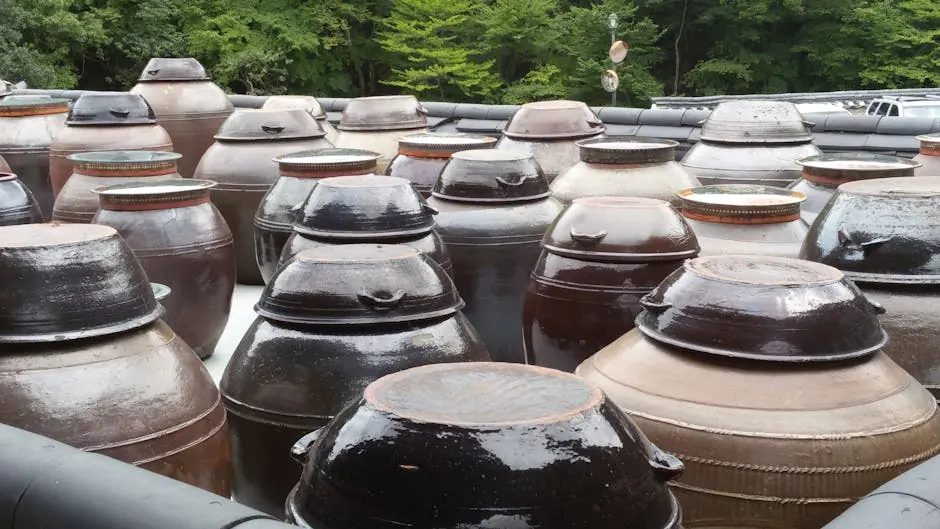
The seventh register, and one of the more underrated registers in the contemporary Gangnam editorial frame, is onggi — the breathing earthenware tradition that has been the Korean pantry's vessel of choice for fermented foods across the older centuries. Onggi has, in the past decade, moved from the kitchen-shed register to the design-floor register; the contemporary masters have been articulating small-format work — tea caddies, flower vessels, footed jars in the table-top scale, the rounded oil-and-vinegar pourers — that reads at the standard the better Hong Kong design lofts have been catching up to. The register's discipline reads in the clay's iron content and the firing's wood-fuel signature; a serious onggi object holds the kiln's smoke signature on the surface and the breathing porosity at depth, both of which read in the object's hand and in the way the surface catches light. The smaller corridor ateliers carry maker-named work in the master-craftsperson register; the airport's craft windows compress the discipline into the production register, and a careful traveller should weight the corridor's smaller showrooms accordingly. Strengths to look for: - Master named with the kiln's region articulated (Mungyeong, Yeoju, and Boryeong all carry distinct onggi traditions) - Wood-fuel firing signature visible on the surface with the kiln-smoke arc articulated - Clay iron-content discussed and the breathing porosity demonstrated at the consult - Climate-conditioning guidance for the destination's humidity register Specialty: Small-format onggi (tea caddies, flower vessels, footed jars, rounded pourers). Pricing tier: $$ (the maker-named small-format work runs ₩240,000 to ₩780,000 in the corridor's better showrooms). Location range: A small number of Cheongdam- and Apgujeong-side design showrooms carry the master-named register; the larger department-store craft floors carry an accessible contemporary register, and the Galleria's craft floor's onggi window has been one of the most consistent in the corridor across the past few seasons.
— Brassware (yugi) and pewter in the small-vessel register
The eighth register is yugi — Korean brassware, in the older Andong-region tradition that has been alloyed and beaten by the same families across multiple generations. The objects worth attending to are small — incense burners, footed cups, the small lidded boxes the older Joseon scholars carried — and the register's discipline reads in the alloy's resonance and the hammered surface's texture. A serious yugi object should ring at a particular pitch when the rim is struck (the Andong masters tune the alloy's copper-tin ratio to a recognisable register), the hammered surface should hold the maker's hand-rhythm at depth, and the patina should be articulable across an aging arc rather than treated as a tarnish. The contemporary Korean brassware masters have, in the past decade, been re-articulating the older forms in a small-format register that travels well in the suitcase; the Andong masters' work sits in the upper bracket, and a small number of Cheongdam-side showrooms carry the master-named work alongside the more accessible contemporary register. Pewter (baekdong) in the same register reads as a quieter cousin and travels well alongside the yugi register on a coffee-table arrangement. Strengths to look for: - Alloy ratio articulated and the kiln-region tradition named - Hammered surface visible at the rim with the maker-rhythm legible across the surface - Aging arc articulated with the patina-care guidance offered - Acoustic register demonstrated at the consult (the resonance is a maker-signature) Specialty: Small-format yugi (incense burners, footed cups, lidded boxes) and baekdong pewter in the matching register. Pricing tier: $$$ (the Andong master-named work runs ₩680,000 to ₩3,400,000 for a small object). Location range: The Cheongdam- and Apgujeong-side specialist showrooms carry the master-named register; the Galleria's craft floor carries a curated selection that reads as a useful entry point, and a careful traveller should expect the master-named register to read above the corridor's department-store offerings.
— Korean fragrance and bath objects in the apothecary register
The ninth register is the contemporary Korean apothecary register — the small Sinsa- and Hannam-side perfumers who have been re-articulating the older oriental-medicine herb registers in fragrance, the bath-soak objects that draw on the older mugwort and ssuk traditions, and the small-format candle work that pairs hanji wicks with native botanicals. The register's discipline reads in the source-material register and the formulation's restraint. A serious Korean apothecary object should name its source materials in the older oriental-medicine register (insam, danggwi, hwanggi all carry distinct registers, as do the mountain-foraged ingredients the better workshops still source from the Gangwon highlands), articulate the formulation's restraint (a perfumer's brief in the older Korean register tends toward the under-articulated rather than the maximalist), and pair the object with a use-arc the buyer can sustain in the destination climate. The bath-soak register travels particularly well on the long flight home — the dried-mugwort sachets, the ssuk-wrapped infusion bricks, the hanji-bagged scrub formulations all compress in the suitcase without compromising the formulation. The Galleria's apothecary corner and a small number of Hannam-side perfumers' rooms carry the maker-named register; the corridor's department-store skincare floors carry a separate, more commercial register that should be read alongside but not as a substitute. Strengths to look for: - Source materials named in the older oriental-medicine register with the regional foraging or cultivation articulated - Formulation's restraint legible (a serious Korean apothecary object tends toward fewer ingredients rather than more) - Hanji or natural-fibre packaging that holds the object's formulation register - Use-arc articulated for the destination climate and the long-flight transit Specialty: Korean apothecary fragrance, bath-soak objects, and small-format candle work in the native-botanical register. Pricing tier: $$ (the maker-named work runs ₩120,000 to ₩620,000 in the corridor's better perfumers' rooms). Location range: The Hannam- and Sinsa-side perfumers' rooms carry the longest contemporary register, the Galleria's apothecary corner carries a curated selection, and a small number of Bukchon-side workshops carry the older oriental-medicine register in its more traditional form.
— Calligraphy and seal-carving in the small-object register
The tenth register, and one of the most particular registers a careful traveller can carry home, is the calligraphic and seal-carving register — the small-format scholar's-objects that the older Korean literati tradition (sarangbang) carried on the writing-table, and that the contemporary Insadong and Bukchon masters have been re-articulating for a small but careful market. The objects worth attending to are not the wall-scroll-format calligraphy the airport carries; they are the small-format pieces — a single character on a hand-pressed hanji square, a personal-seal carved on a Goryeo-stone register, a brush-rest in the older bronze-or-ceramic tradition, a small ink-stone that reads at the standard a Hong Kong literati flat would recognise. The register's discipline reads in the master's training arc and the object's form-discipline. A serious calligraphic object should carry the master's seal in addition to the work, the brush should be articulable in its hair-source (the older Korean register favours the goat- and weasel-hair traditions in distinct ways), and the seal-carving work should hold the chisel's signature at the character's edge. 坐低慢慢睇, as the Cantonese viewing register has it; the calligraphic object asks to be read slowly, and the better corridor masters will pour a tea while the buyer reads. Strengths to look for: - Master's training arc articulated with the calligraphic lineage discussed - Master's seal present alongside the work and the date articulated - Hanji or stone provenance named with the workshop's regional tradition - Display guidance offered for the destination's lighting and humidity arc Specialty: Small-format calligraphy, seal-carving, and the literati-register scholar's-objects. Pricing tier: $$ to $$$ (the small-format master-named work runs ₩180,000 to ₩2,400,000, and the personal-seal commissions run in the upper bracket). Location range: The Insadong masters' rooms carry the longest tradition, but a small number of Bukchon and Cheongdam-side ateliers carry contemporary master-named work; the Galleria's craft floor carries a curated selection in the more accessible register, and a careful walk should sample the smaller masters' rooms first.
Comparison register — what each category asks of the suitcase and the shelf
A categorical reading of the ten registers helps the careful traveller plan the walking edit and the suitcase capacity. The table below sets out, for each register, the indicative pricing tier, the suitcase-fragility signal, the climate-sensitivity reading, and the coffee-table use-register. The table is descriptive rather than ranked, and the entries should be read alongside the longer category notes above; an object's place on the shelf is decided in the room it ends up in, and the table is a planning instrument rather than a verdict.
| Register | Pricing tier | Fragility (suitcase) | Climate sensitivity | Coffee-table use |
|---|---|---|---|---|
| Celadon and buncheong ceramics | $$ to $$$ | High — wrap layered, hand-carry advisable | Low — stable across humidity arcs | Display object, brush-washer, tea bowl |
| Hanji paper objects | $ to $$ | Medium — flat-pack travels well, lamp-formats need care | Medium — humid climates ask for conservation register | Lamp, framed paper-cut, notebook, tray |
| Korean tea (loose-leaf and bricks) | $$ to $$$ | Low — sealed tin or hanji-wrap travels straightforwardly | Medium — storage protocol matters at destination | Display brick, decanted into ceramic caddy |
| Incense (chimhyang, songji) | $$$ | Low — boxed format travels well | High — humidity arc affects formulation | Powdered box with paired burner, cone-set |
| Najeonchilgi lacquer boxes | $$$ | Medium — hand-carry advisable for the larger pieces | Medium — sustained humidity asks for conditioning | Jewellery box, calling-card case, document tray |
| Norigae silk accessories | $$ | Low — flat-pack with the knot's geometry preserved | Medium — silk's longer arc asks for shaded display | Framed shadow-box, cabinet-display |
| Onggi small vessels | $$ | Medium — wrap layered, hand-carry for footed work | Low to medium — porosity reads with the use-register | Tea caddy, flower vessel, footed jar |
| Yugi brassware and baekdong pewter | $$$ | Low — solid alloy travels straightforwardly | Low — patina-care is the longer arc | Incense burner, footed cup, lidded box |
| Apothecary fragrance and bath | $$ | Low — sealed formats travel routinely | Medium — formulation's longer arc reads at destination | Display tray, cabinet, bath-side |
| Calligraphy and seal-carving | $$ to $$$ | Low to medium — flat-pack for hanji, padded for stone | Medium — UV exposure ask the framed work for shaded display | Framed hanji square, personal-seal display, scholar's-table |
Editorial note — on the walking edit and the longer aftercare arc
The walking edit a careful traveller assembles in Gangnam should sit, in its rhythm, alongside the rest of the trip's longer arc rather than as a single afternoon's compression. The corridor's better ateliers — and this matters — read more clearly when the buyer arrives unhurried; the shopkeeper will pour a tea, the accompanying card or biographical pamphlet will be offered, and the conversation will articulate the object's register in the longer paragraph the airport-shop format does not allow for. A useful editorial discipline a careful traveller should consider is to walk the corridor twice — the first walk a reading walk, the second walk a buying walk — with a day's pause in between. The pause matters: the objects worth carrying back are objects that read at depth rather than at surface, and the depth reads better with a night's separation between the first encounter and the commitment. A second editorial discipline is to read the destination's longer arc into the buying decision. A coffee table in a humid Causeway Bay flat will hold a celadon bowl and a najeonchilgi box without effort, but will read a hanji lamp differently than a temperate-climate flat would; a careful walk should weight the climate-sensitivity register alongside the aesthetic one. The corridor's better ateliers will offer climate guidance as a routine matter, and the buyer should expect that conversation as part of the object's price.
Frequently asked questions
How much should a careful traveller budget for a single coffee-table-quality object from Gangnam?
A categorical reading of the corridor's better ateliers reads a useful single-object budget in the ₩300,000 to ₩1,200,000 register for the more accessible categories (small ceramics, hanji small-format, norigae, onggi, apothecary), and the ₩900,000 to ₩4,800,000 register for the master-named registers (chimhyang incense, najeonchilgi lacquer, Andong yugi, calligraphic master-work). A travelling edit of three to five objects from the corridor reads, in the conservative budgeting frame, around ₩1,500,000 to ₩6,000,000 in total.
Are these registers carried at Incheon Airport's duty-free, or do they ask for a Gangnam walk?
The airport carries an accessible contemporary register across most of the categories, but the master-named work and the longer-form atelier conversation do not compress into the airport format. A careful traveller should treat the airport's craft windows as a supplementary register rather than a substitute, and weight the corridor's smaller ateliers above the duty-free format for any object meant to carry the longer aesthetic arc.
How does the Korean register compare to the Japanese or Chinese craft registers a Hong Kong buyer might already be familiar with?
The Korean register sits alongside the Japanese and the Chinese as the third pillar of the East Asian craft canon, but reads as the quietest of the three — the celadon's restraint, the najeonchilgi's structural understatement, the chimhyang's thinner-smoke aromatic — and the buyer accustomed to the more articulated Japanese registers (kintsugi, urushi, kodo) or the more decorative Chinese registers (jingdezhen, cloisonne, tea-brick) should read the Korean register on its own categorical terms rather than as a substitute for either adjacent canon.
Which register travels best on a long-haul flight from Seoul to Hong Kong or onward to Europe?
The long-haul transit reads most kindly to the boxed, sealed, or solid-alloy formats — chimhyang incense in lacquered boxes, yugi brassware, sealed loose-leaf tea, hanji-wrapped tea bricks, najeonchilgi small-format work, and the smaller seal-carving objects all travel routinely. The fragile registers (celadon and buncheong ceramics, larger hanji lamp-formats, footed onggi) ask for hand-carry and a layered wrap; the corridor's better ateliers will arrange the wrapping as a matter of routine, and the buyer should articulate the destination at the consult.
Are these registers available in the Galleria's and Shinsegae's craft floors, or do they ask for the smaller ateliers?
The Galleria's craft floor and the Shinsegae's home and craft register both carry curated selections across most of the ten registers, and read as useful starting points for a careful walking edit. The master-named work and the longest-form atelier conversation, however, sit in the smaller corridor ateliers — the side streets off Apgujeong-ro, the Sinsa- and Garosu-gil-side stationers, the Cheongdam specialist showrooms, and the Bukchon and Insadong masters' rooms — and a fuller editorial reading should sample both the department-store register and the smaller atelier register.
What is the single most underrated register in the contemporary Gangnam editorial frame?
A careful editorial reading of the past five seasons reads the onggi register as the most underrated category — the contemporary masters have been articulating small-format work at the standard the better Hong Kong and Taipei design lofts have been catching up to, and the small-format pricing register sits below the recognition the work increasingly reads at. The Apothecary register reads as the second most underrated, particularly the contemporary perfumers' work in the older oriental-medicine herb tradition; both registers reward an unhurried walk and a longer atelier conversation.
Are any of these registers regulated for export, and what should a careful traveller know about Korean customs?
The Korean Cultural Heritage Administration regulates the export of designated cultural-heritage objects, and a small number of master-named works in the najeonchilgi, yugi, and calligraphic-and-seal-carving registers may sit in the regulated category. A careful traveller should expect the corridor's better ateliers to articulate the export framework at the consult, and the master-named work should arrive with the appropriate documentation. The Korea Customs Service publishes the cultural-heritage export framework on its English-language portal, and the buyer should treat the documentation as part of the object's longer arc.
How should the coffee-table arrangement read once the objects are home?
A categorical reading of the better Hong Kong and Taipei flats reads a coffee-table arrangement of three to five objects from the registers above as the editorial sweet spot — a single ceramic in the buncheong or celadon register as the anchor, a smaller najeonchilgi or yugi object as the structural counterpoint, a hanji-wrapped tea brick or chimhyang box as the aromatic register, and a calligraphic small-format piece as the literary anchor. The arrangement reads more clearly when the registers are mixed across material rather than concentrated in one; the corridor's better ateliers will counsel the same disposition when asked.