A Reader's Seoul
Halal and Vegan-Friendly Tables in Gangnam: A Discreet Map
A working map of the certified halal kitchens, plant-forward dining rooms, and quiet alternatives that have, in recent years, made Gangnam a serious table for MENA and Southeast Asian visitors.
Gangnam's halal and plant-forward dining reads, on first impression, as it does in Causeway Bay around the Wan Chai mosque — concentrated, discreet, and better than the casual visitor first assumes. The certified rooms are not the loud ones. They sit on second floors above Sinsa boutiques and on quiet stretches of Yeoksam, with placards small enough that one walks past them twice. Plant-forward kitchens here have, in four years, moved past a derivative Tokyo vegan response into something with its own grammar. 呢度真係有得揀, a Kuala Lumpur friend texted after her third dinner. She wasn't wrong.
What halal-friendly actually means in Gangnam in 2026
Halal-friendly in Gangnam, as the local industry now uses the term, refers to a four-tier framework adopted in line with the Korea Tourism Organization's classification — Certified, Self-Certified, Halal-Friendly, and Pork-Free — and it is the framework one should keep in mind before booking a table. The Certified tier sits at the top: kitchens audited by the Korea Muslim Federation, with documentation that travels MENA and Southeast Asian standards reasonably well. The Self-Certified tier covers Muslim-owned kitchens whose owners attest to the sourcing without a third-party audit. The Halal-Friendly tier — the largest, in practice — covers Korean and international kitchens that maintain a separate halal menu and a documented sourcing chain for those dishes, though the broader kitchen is not halal. The Pork-Free tier is exactly what it sounds like, and it is the loosest of the four. What recommends Gangnam over the older Itaewon corridor is not the breadth of the Certified tier — Itaewon still leads on that — but the quality of the Halal-Friendly rooms. The neighbourhood between Apgujeong and Yeoksam has become, in my reading, the city's most credible scene for visitors who want the dining standards of a Lee Garden Three lunch alongside genuine sourcing transparency. The placards are small; the documentation, when one asks, is not.

The certified halal rooms worth a detour
The certified halal rooms in Gangnam proper are fewer than the Itaewon corridor's, but the ones that exist are worth a deliberate detour. EID, an Indian-Pakistani room near Sinsa station, holds a Korea Muslim Federation certificate that has been current for several years; the kitchen is visible through a glass partition, the lamb biryani is precise, and the staff handle the prayer-time accommodations without any production. A few blocks east, Murree Pakistani Restaurant on a Yeoksam side street keeps a similar register — small footprint, certified, and the kind of room a Karachi-trained traveller will recognise immediately. For Indonesian and Malaysian palates, Warung Bali in Sinsa runs a quieter operation with a documented halal sourcing chain for its rendang and gado-gado, though it sits in the Halal-Friendly tier rather than fully certified. The pattern across the certified rooms is consistent: small, family-run, generally serving lunch from noon and dinner from six, and best approached on a weekday afternoon when the room is genuinely quiet. One arrives, one is seated, one is offered water without commentary. The hospitality reads, on first impression, as undramatic — which is exactly what most travellers from Doha or Jakarta tell me they were hoping for.
Halal-friendly hotel and Korean dining
Halal-friendly Korean dining — the question MENA and Southeast Asian visitors actually ask most often — has matured considerably in Gangnam over the past three years, and it now answers a real need. The flagship is the Grand InterContinental Seoul Parnas, which maintains a halal-certified kitchen line through its Asian Live restaurant and can prepare a credible Korean royal-cuisine tasting on request, with twenty-four hours' notice. JW Marriott Dongdaemun and Lotte Hotel Seoul run similar programmes through their banquet kitchens, though the in-restaurant offering is narrower. For Korean barbeque specifically — the request that comes up almost daily — Makan Halal Korean BBQ in Itaewon remains the credible benchmark, but Gangnam's own Yang Good in Sinsa has begun running a halal-friendly evening service on Tuesdays and Thursdays with imported certified beef and a separate grill rotation. The price point is meaningful: thirty to forty per cent above the standard Korean barbeque average, which is the cost of the sourcing transparency. What recommends these rooms is not novelty but the absence of theatre — the staff know the protocol, the kitchen runs the separation cleanly, and no one at the table is asked to explain themselves twice. For a wellness-focused itinerary, this matters more than the menu length.
The plant-forward and vegan tier
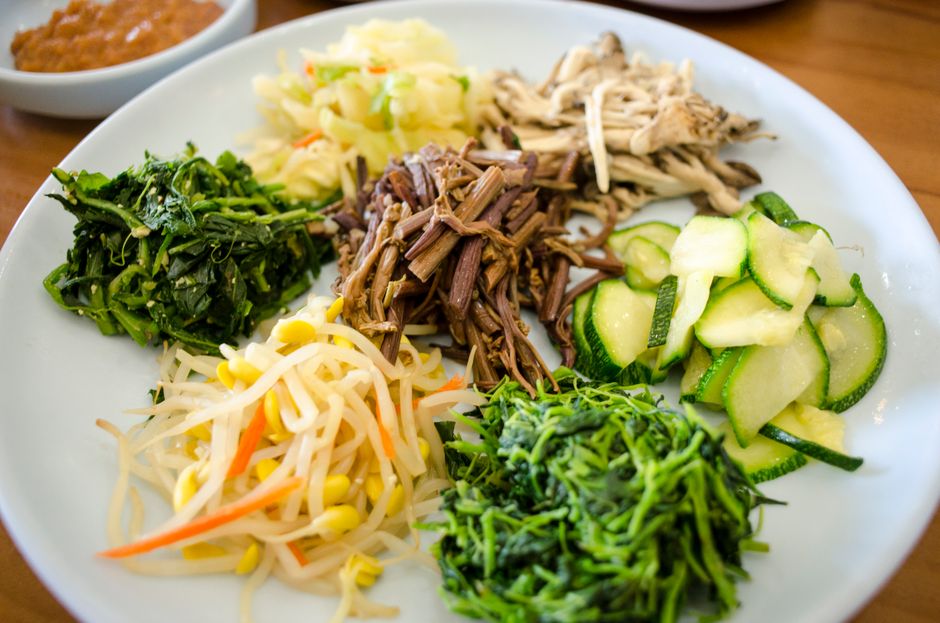
Gangnam's plant-forward scene reads quieter than Hannam-dong's and considerably more restrained than the Tokyo or Melbourne equivalents — which is, for the wellness traveller, precisely the appeal. The flagship is Plant Cafe Gangnam in Sinsa, which has been operating since 2019 and now runs a fully vegan menu that crosses Korean temple cuisine with Mediterranean and Levantine techniques; the room seats twenty-two and the lunch service is the more interesting one. A few minutes south, Veggie Holic occupies a basement space near Garosu-gil that is gentler on the eye than its name suggests — long communal table, low lighting, a rotating chef's tasting that draws from Korean monastic tradition. Then there is Soshig in Apgujeong, which runs a high-end vegan tasting menu in the register of a Tokyo kaiseki room — eight courses, reservation only, and a wine-pairing list that includes natural wines from Gyeonggi-do producers. The middle of the tier covers Bbushim Vegan in Sinsa, Saechobang for Korean temple-style dining, and a handful of plant-based bakeries along Apgujeong-ro. The price differential versus the omnivore equivalent is modest at the casual end and significant at the tasting-menu end — which tracks the Tokyo and Hong Kong patterns I know well. The room — and this matters — is rarely louder than a private library.

Where the two scenes overlap: prayer rooms, fasting hours, and quiet corners
Where halal and plant-forward dining overlap, in Gangnam, is in the practical infrastructure that surrounds the meal — prayer-room access, fasting-hour kitchens during Ramadan, and the question of what one does in the hour before and after the table. The Seoul Central Mosque sits in Itaewon, roughly a fifteen-minute taxi ride from most Gangnam clinic addresses, and it remains the city's principal congregational space; the Korea Muslim Federation maintains an updated map of smaller mussallah locations across Seoul, and the Lotte Department Store in Jamsil now keeps a quiet prayer space accessible during operating hours. Within Gangnam itself, the COEX Mall has a small designated room near the lower-level food court, and several of the larger hotels — InterContinental, JW Marriott, Lotte — provide prayer mats and Qibla direction on request without commentary. During Ramadan, EID and Murree both extend their evening hours and offer a fixed iftar menu; Plant Cafe Gangnam runs a parallel sehri-friendly breakfast on weekdays during the month, which the Indonesian community in Gangnam has been quietly grateful for. For travellers building a recovery-focused itinerary alongside a clinic appointment, this layered infrastructure — the kind of layered infrastructure one quietly relies on in Causeway Bay or Lan Kwai Fong — has become the real reason Gangnam now competes with Itaewon for MENA visitor share.
A practical map: twelve rooms by tier
The twelve rooms below are the ones I return to in Gangnam between appointments and across visits, organised by tier rather than ranked — certified halal, halal-friendly Korean and international, and the plant-forward flagships. I have left out the rooms that exist primarily for a tourist queue and the ones whose certification has, on the most recent check, lapsed. Each address sits a short walk from a major Sinsa, Apgujeong, or Yeoksam landmark, and most of the upper-tier rooms accept reservations through KakaoTalk channels or through the Korea Tourism Organization's halal restaurant portal, which I would recommend as the first reference point for any visitor planning a multi-day itinerary. A note on hours: the certified halal rooms tend to close on Sunday evenings or run a reduced service, and the plant-forward rooms keep a Tuesday-to-Saturday rhythm at the higher end. Plan accordingly.
| Tier | Room | Cuisine | Neighbourhood |
|---|---|---|---|
| Certified halal | EID | Indian-Pakistani | Sinsa |
| Certified halal | Murree Pakistani | Pakistani | Yeoksam |
| Halal-friendly | Warung Bali | Indonesian | Sinsa |
| Halal-friendly | Yang Good (T/Th service) | Korean BBQ | Sinsa |
| Halal-friendly | Asian Live (InterContinental Parnas) | Pan-Asian | Samseong |
| Halal-friendly | Makan Halal (Itaewon, near Gangnam) | Korean BBQ | Itaewon |
| Plant-forward upper | Soshig | Vegan tasting menu | Apgujeong |
| Plant-forward middle | Plant Cafe Gangnam | Vegan Korean-Mediterranean | Sinsa |
| Plant-forward middle | Veggie Holic | Korean temple-style | Garosu-gil |
| Plant-forward middle | Bbushim Vegan | Korean vegan | Sinsa |
| Plant-forward casual | Saechobang | Temple cuisine | Yeoksam |
| Plant-forward casual | Plant-based bakeries (Apgujeong-ro) | Bakery | Apgujeong |
How the dining scene fits a wellness itinerary
A halal or plant-forward dining itinerary in Gangnam, treated alongside a wellness consultation, settles into a rhythm I now recognise across most of the visitors I host — a late breakfast at one of the plant-forward rooms or hotel halal kitchens, a midday clinic appointment, an early afternoon at a quiet roastery, and a dinner at one of the certified halal rooms or a vegan tasting menu. The lighting in the upper-tier rooms — both halal and plant-forward — sits at the gentler end of the kelvin range, which the post-treatment afternoon repays. The seating is upholstered, the staff trained in the kind of discreet hospitality the Mandarin Oriental's Cake Shop has long set the bar on. For visitors building this itinerary alongside a regenerative or stem cell consultation, the related guides on this site cover the broader question of what to do in Gangnam between appointments and the Apgujeong dining guide for the omnivore evenings on the same trip. The dining infrastructure here, treated as part of the recovery rhythm rather than as a separate question, has become the single most undervalued reason MENA and Southeast Asian visitors now choose Gangnam over Itaewon for a wellness-focused stay.
“The certified rooms are not the loud ones — they sit on second floors above Sinsa boutiques, with placards small enough that one walks past them twice before noticing.”
Liu Mei-Hua, on Gangnam's halal dining infrastructure
Frequently asked questions
Are there fully certified halal restaurants inside Gangnam itself, or is Itaewon still the main address?
Itaewon still leads on the Certified tier in absolute terms, but Gangnam now holds a workable cluster of its own — EID and Murree are the two most reliable certified rooms in the district, with several Halal-Friendly and hotel kitchens supporting them. For a multi-day stay, the Gangnam scene is sufficient on its own; for a single dedicated halal evening, an Itaewon detour remains worth the taxi.
How do MENA visitors usually verify a kitchen's certification before booking?
The Korea Tourism Organization's halal restaurant portal is the first reference point and lists the four-tier classification cleanly. Most certified rooms display the Korea Muslim Federation placard near the entrance and will produce documentation on request. For visitors arriving from Doha, Riyadh, or Jakarta, asking the hotel concierge to call ahead is the customary practice and is rarely refused.
Is Gangnam a credible vegan destination compared to Tokyo or Hong Kong?
It is now, in my reading. The upper-tier rooms — Soshig, Plant Cafe Gangnam, Veggie Holic — sit comfortably alongside their Tokyo and Hong Kong equivalents on technique, and the Korean temple-cuisine lineage gives the local scene a depth the others do not quite match. The price point is gentler than Tokyo and roughly level with Hong Kong's better rooms.
Are prayer rooms accessible from the Gangnam clinic district?
The Seoul Central Mosque is fifteen minutes by taxi from most clinic addresses. Within Gangnam, the COEX Mall has a small designated prayer space, and the InterContinental Parnas, JW Marriott Dongdaemun, and Lotte Hotel Seoul provide prayer mats and Qibla direction on request without theatre. The Korea Muslim Federation publishes an updated mussallah map for Seoul that is worth saving.
What changes during Ramadan for a visitor staying in Gangnam?
EID and Murree extend evening hours and run fixed iftar menus during the month. Plant Cafe Gangnam offers a sehri-friendly breakfast on weekdays. The InterContinental Parnas and several other large hotels run buffet-style iftar service. Clinic appointments, in my experience, accommodate fasting visitors gracefully, with most kitchens offering a private suhoor option through room service on request.
Are vegan kitchens in Gangnam suitable after a non-invasive procedure?
Most upper-tier vegan rooms read as well-suited to the post-treatment afternoon — gentle lighting, quiet seating, kitchens that handle dietary requests without commentary. Patients report a range of physician guidance on specific food sensitivities; the courtesy of the better rooms is that the conversation is unnecessary. Soshig and Plant Cafe Gangnam are the two I most reliably recommend for the recovery window.
What is the typical price range across the halal and plant-forward tiers?
Certified halal rooms run twenty to thirty thousand won for a generous lunch and forty to sixty thousand for dinner. Halal-friendly hotel kitchens sit higher — eighty to one hundred and fifty thousand won for a full dinner. Plant-forward casual rooms run fifteen to twenty-five thousand won at lunch; the upper-tier vegan tasting menus sit at one hundred and twenty to two hundred thousand won, comparable to a Tokyo equivalent.