The Plain Term
Seoul Travel Glossary for the Hong Kong Reader
Fifty terms — from the AREX to the yum cha analogue — for the Hong Kong traveller who reads the menu before ordering.
Seoul reads, on first impression, like a wider Causeway Bay — vertical, layered, faster than it looks. For the Hong Kong traveller the city is legible in ways Tokyo or Shanghai are not; one recognises the density, the lift culture, the polite efficiency of the queue. What is unfamiliar — and this matters — is the vocabulary surrounding it. 先睇清楚個 menu 先點餐, as my mother would say. The fifty entries that follow, A through Z, cover the transit lines, the food register, the cultural codes, and the small administrative phrases a Hong Kong reader will meet between Incheon arrival and the flight home. None of it is exhaustive. All of it is what I wish someone had handed me on my first visit.
A
The A-letter entries cover arrival logistics and the first orientation — the airport line, the address protocol, and the apartment-stay register that increasingly competes with the hotel.
AREX (Airport Railroad Express)
AREX is the dedicated rail link between Incheon International (ICN) and central Seoul, running both an Express service to Seoul Station — forty-three minutes, reserved seating, no transfers — and an All-Stop service that doubles as a commuter line. For the Hong Kong arrival the Express compares to the Airport Express from Chek Lap Kok in cadence and price discipline, though Seoul's pricing sits roughly thirty per cent below MTR equivalents. The Express terminates at Seoul Station, where one transfers to KTX, Line 1, or Line 4. Tip: the Express does not run twenty-four hours — last train is roughly 22:48. See also: ICN, Seoul Station.
Address Format (Korean)
Korean addresses follow a road-name system — gu (district), ro or gil (road or alley), and a building number — which reads in the opposite direction to a Hong Kong address. A clinic at 123 Apgujeong-ro, Gangnam-gu, Seoul is, in Hong Kong syntax, closer to Gangnam-gu first, Apgujeong-ro second, building third. Most taxi drivers and Naver Map searches accept either the road-name address or the older lot-number system, but the road-name version is the official one since 2014. For Hong Kong readers the cleanest workflow is to copy the Korean-script address into KakaoMap rather than transliterate. See also: KakaoMap, Naver Map.
Apgujeong
Apgujeong — the district immediately north of the Han River, anchored on Apgujeong Rodeo Drive and the Galleria Department Store — is the historical centre of Seoul's luxury-retail and aesthetic-medicine cluster. For the Hong Kong reader the analogue is closer to Lee Garden Three than to Central — quieter entrances, marble lobbies, the same discreet density. The neighbouring Cheongdam district has drawn the newer high-end addresses; the two are walking distance apart on Apgujeong-ro. A Hong Kong visitor staying in Apgujeong has, on foot, access to the bulk of the city's curated wellness rooms. See also: Cheongdam, Gangnam-gu.
Apartment Hotel (Serviced Residence)
The Korean serviced residence — ** in conversational Korean — is a hybrid hotel-apartment category that has expanded sharply in Gangnam over the last decade, offering longer-stay rooms with kitchenettes, washing machines, and weekly housekeeping. For the Hong Kong reader the closest analogue is the Shama or Ovolo serviced-residence register; the Seoul versions sit at roughly seventy per cent of the Hong Kong nightly rate. The category suits the medical traveller staying ten to fourteen days more than the conventional hotel. See also: Hanok Stay, Officetel.
B
The B-letter entries cover the foundational food and transit vocabulary — the bus etiquette, the bingsu cafes, and the banchan protocol that anchors most Korean meals.
Banchan
Banchan are the small side dishes — kimchi, pickled radish, seasoned spinach, anchovies, occasionally a savoury egg custard — served alongside the main course at virtually every Korean meal. The dishes are, by convention, refilled at no charge, a practice that surprises Hong Kong diners accustomed to the cha chaan teng set-meal model where extras are itemised. Banchan are not appetisers in the European sense; they are eaten throughout the meal, in small bites between mouthfuls of rice. The number and quality of banchan is a quiet signal of the kitchen's seriousness. See also: Kimchi, Set Menu.
Bingsu
Bingsu is the Korean shaved-ice dessert — a mound of finely shaved milk-ice topped with red bean, fresh fruit, condensed milk, mochi, or matcha — served in cafe portions large enough for two. The category sits somewhere between a Hong Kong tong sui and a Taiwanese xue hua bing, though the Korean version uses milk-ice rather than water-ice, producing a softer texture. The Sulbing and Snowy Village chains are the dependable mid-tier; the Apgujeong cafes serve more curated versions at roughly twice the price. See also: Cafe Culture, Patbingsu.
Bukchon Hanok Village
Bukchon is the preserved hanok district between Gyeongbokgung and Changdeokgung palaces — five hundred-odd traditional Korean wooden houses arranged on the slope, many converted into tea houses, craft studios, and small museums. For the Hong Kong reader Bukchon reads as the Seoul equivalent of a Sheung Wan heritage walk, though quieter and more residential. Important: residents still live there. Photographs are encouraged in marked zones only; the alleys carry signs requesting silence. See also: Hanok Stay, Gyeongbokgung.
Bus (City)
Seoul's city buses run a four-colour system — blue for trunk routes, green for neighbourhood feeders, red for express commuter lines, yellow for the central business district loop — and accept the same T-Money card as the metro. The cadence is faster than Hong Kong's KMB equivalent and the routes are denser, though English-language signage on the bus itself is minimal. The Naver Map application gives accurate live arrival times. Tip: the rear-door exit must be tapped on disembarkation, or the next ride is charged at the full base fare. See also: T-Money, Naver Map.
C
The C-letter entries cover the central districts and the cafe-to-convenience-store rhythm that structures most Seoul days.
Cheongdam
Cheongdam — the district immediately east of Apgujeong, anchored on Cheongdam-ro and the luxury-retail strip running toward Galleria West — has, in the last fifteen years, become the address one expects for the higher-fee aesthetic and regenerative clinics, the boutique galleries, and the discreet hotel-residences. The district reads, in Hong Kong shorthand, as the Seoul answer to a Lee Garden Three ground-floor cluster — quiet entrances, marble lobbies, lifts that run directly to the consultation floor. A Cheongdam address is a register, not a credential. See also: Apgujeong, Galleria.
Convenience Store (CU, GS25, 7-Eleven)
The Korean convenience store — chiefly CU, GS25, and 7-Eleven — operates at a density and quality the Hong Kong Circle K and 7-Eleven reader will recognise but find quietly elevated. The shelves carry hot meals, fresh kimbap, banana milk, soju in flavoured varieties, and a respectable selection of pharmacy-adjacent goods. For the recovering medical traveller the convenience store is the late-evening pharmacy substitute and the small-meal option when the hotel restaurant has closed. 呢度好實用. See also: Pharmacy, Banana Milk.
Cafe Culture
Seoul cafes are not, in the Hong Kong sense, places to wait between appointments — they are the appointment. The city carries an estimated 18,000 cafes within the metropolitan area, ranging from the third-wave specialty roasters of Seongsu to the dessert-led rooms of Apgujeong. A cafe visit runs ninety minutes, not fifteen; ordering a single drink to occupy a table for two hours is socially permitted. For the Hong Kong reader accustomed to cha chaan teng turn-over the pacing is slower, the seating more generous, and the wifi consistently faster. See also: Bingsu, Seongsu.
Coupang
Coupang is the dominant Korean e-commerce platform — the Seoul equivalent of HKTVmall, with the cadence and inventory closer to Amazon Prime than to a domestic supermarket app. Same-day delivery, called Rocket Delivery, covers most of central Seoul before midnight if ordered before noon. For the longer-stay traveller in a serviced residence the application solves the late-evening pharmacy run, the missed-toiletry problem, and the recovery-week grocery order. The interface supports English. See also: Apartment Hotel, Convenience Store.
D
The D-letter entries cover the dining and duty-free vocabulary — the dolsot rice bowl, the department-store food halls, and the duty-free arithmetic that still favours Seoul over Hong Kong on certain categories.
Dolsot Bibimbap
Dolsot bibimbap is the stone-bowl version of the more familiar bibimbap — a rice, vegetable, and gochujang assemblage served in a heated stone vessel that crisps the bottom layer of rice into the nurungji crust most diners consider the best part of the dish. The Jeonju regional version is the canonical reference; in Seoul the better rooms are in Insadong and the older Jongno alleys. For the Hong Kong reader the dish reads closer to a bao zai fan than to a tossed salad. See also: Banchan, Gochujang.
Department Store Food Hall
The Korean department-store food hall — Shinsegae Gangnam, Lotte Avenuel, Galleria — operates at a quality level Hong Kong's City Super and Great food halls will recognise but generally exceed in the prepared-food and patisserie sections. The basement floors carry full-meal counters, premium sushi, regional Korean specialties, and bakery rooms that supply the city's better hotel concierges. For the medical traveller the food hall is the discreet recovery-meal solution — sit-down counters with reliable hygiene and full English menus on tablet. See also: Shinsegae, Galleria.
Duty-Free (Lotte, Shilla, Shinsegae)
Korean duty-free — Lotte, Shilla, and Shinsegae the three dominant operators — works on a pre-order-in-city, collect-at-airport model that is unfamiliar to most Hong Kong travellers used to airport-only purchase. One reserves online or in the downtown duty-free floor; the goods are released at the ICN departure gate. On K-beauty, fragrance, and Korean tobacco the pricing routinely undercuts Hong Kong duty-free; on European luxury leather the differential is narrower. See also: ICN, K-Beauty.
Dongdaemun
Dongdaemun is the wholesale-fashion and night-market district in central-east Seoul, anchored on the Zaha Hadid-designed DDP — Dongdaemun Design Plaza — and the cluster of twenty-four-hour fashion towers running along Cheonggyecheon stream. The district trades from approximately 22:00 until dawn at the wholesale level; the retail shops follow daytime hours. For the Hong Kong reader the market reads as a denser, faster Mongkok with a stronger fashion-buying bias. See also: DDP, Mongkok analogue.
E
The E-letter entries cover the entry-document and exchange-rate vocabulary — the K-ETA, the embassy register, and the won-to-Hong-Kong-dollar arithmetic that frames most travel budgets.
Exchange Rate (KRW-HKD)
The KRW-HKD rate sits, at the time of writing, at roughly 175 won to one Hong Kong dollar — a useful mental shortcut is to drop the last two zeroes from a Korean price and approximate the HKD figure. A 25,000 KRW bibimbap reads as approximately HKD 143; a 250,000 KRW hotel night reads as HKD 1,430. For the Hong Kong card-payer the Visa and Mastercard interbank rate routinely beats the airport currency-exchange counter by two to three per cent. See also: Card Payment, T-Money.
Express Bus Terminal
The Seoul Express Bus Terminal — at Banpo, Gangnam-gu — is the central inter-city coach station serving the southern provinces, Busan inclusive. The terminal sits directly on Metro lines 3, 7, and 9, and houses the underground GoTo Mall — eight hundred shops on a six-hundred-metre corridor that operates as the city's cheapest fashion-retail floor. For the Hong Kong reader the terminal-with-mall layout is a familiar pattern. See also: KTX, GoTo Mall.
Etiquette (Bowing, Two-Hand Pour)
Korean dining etiquette requires the two-hand pour — both hands on the bottle when serving someone older or senior — and the slight bow at meeting and parting. The bow is shallower than the Japanese equivalent, more a head-nod than a folded torso. For the Hong Kong reader the cadence is unfamiliar but legible; the soju ritual in particular rewards observation before participation. Important: pouring one's own glass is, in formal company, considered impolite — wait, and your companion will refill. See also: Soju, Hierarchy.
Ewha Womans University District
The Ewha district — north of the Han River, anchored on the Ewha Womans University main gate — is the student-shopping and skincare-retail cluster that, for many Hong Kong visitors, serves as the introduction to mid-tier K-beauty before the Apgujeong escalation. The district reads as a softer, younger Causeway Bay; pricing on cosmetics and accessories sits roughly forty per cent below the Apgujeong department-store equivalents. See also: K-Beauty, Hongdae.
F
The F-letter entries cover the food-court vocabulary and the foreigner-facing service tier — the fried-chicken category, the foreign-patient registration, and the fusion-cafe register that increasingly defines central Gangnam.
Fried Chicken (Chimaek)
Korean fried chicken — chimaek in conversational Korean, a portmanteau of chi-cken and mae-kju, beer — is the late-evening staple that anchors most casual Seoul nights out. The double-fry technique produces a thinner, glassier crust than the Hong Kong soy-sauce-chicken register; the canonical brands are Kyochon, BBQ Olive, and Bonchon, with the smaller artisanal rooms in Mapo and Sinsa-dong. The pairing with draft Cass or Hite beer is part of the dish, not a side. See also: Hongdae, Soju.
Foreign Patient Registration
Korean clinics that accept international patients hold a Foreign Patient Attraction Registration — a Ministry of Health and Welfare licence administered through KHIDI — that the better Seoul aesthetic and regenerative rooms display in the lobby. The registration carries an A-2026-style serial number and confirms the clinic has met the bilingual-staff and consent-pack requirements for foreign-patient intake. For the Hong Kong reader the licence is the equivalent of a Hospital Authority list-entry — not a recommendation, but a baseline. See also: KHIDI, MOHW.
Free Wifi (Public)
Seoul operates one of the densest public-wifi networks in Asia — Seoul Wifi, the open municipal SSID — covering metro stations, buses, and most central streets at speeds adequate for navigation and messaging. The Hong Kong free-wifi register is comparable, but Seoul's coverage extends further into the bus and cafe layer. Tip: the better hotels and cafes still ask for a registration on first connection; bring a roaming SIM or eSIM rather than relying on public wifi exclusively. See also: eSIM, KakaoTalk.
Fusion Cafe
The Seoul fusion cafe — a category that ran its first wave in 2018 and continues to evolve — combines specialty coffee, dessert plating, and a curated retail wall in a single seventy-square-metre room. The Apgujeong, Seongsu, and Hannam-dong examples are, in editorial reading, the most refined; the format has begun to influence the Hong Kong third-wave coffee scene as well. The category rewards a longer visit. See also: Cafe Culture, Seongsu.
G
The G-letter entries cover the geographic anchors — the Gangnam designation, the Gimpo airport alternative, and the Gyeongbokgung palace baseline that orients most central-Seoul itineraries.
Gangnam-gu
Gangnam-gu — literally south of the river — is the administrative district covering the affluent southern bank of the Han, anchored on Gangnam Station, the Apgujeong and Cheongdam clusters, and the Samseong financial corridor. For the Hong Kong reader Gangnam-gu reads as a wider, lower-rise Central — vertical, but spread across thirty-nine square kilometres rather than concentrated on Hong Kong Island's narrow strip. The district is the operational centre for most medical-tourism itineraries. See also: Apgujeong, Samseong.
Gimpo (GMP)
Gimpo International — the older Seoul airport, now serving regional routes to Tokyo Haneda, Osaka, Shanghai, Taipei, and Beijing — sits twenty minutes from Gangnam by AREX or Line 9, considerably closer than Incheon. For the Hong Kong reader arriving on a Cathay or HK Express Hong Kong-Gimpo flight — currently a less common routing — the airport's compactness is a quiet relief. The duty-free is smaller but the immigration queues run faster. See also: ICN, AREX.
Gyeongbokgung
Gyeongbokgung — Palace Greatly Blessed by Heaven — is the principal Joseon-dynasty royal palace, sitting at the head of the central Seoul axis. The grounds open at 09:00 and admission is waived for visitors in hanbok — the traditional dress, hired from the rental shops along the palace walls. For the Hong Kong reader the palace reads as the Seoul equivalent of a Forbidden City visit, quieter and walkable in two hours. The changing-of-the-guard ceremony at 10:00 and 14:00 is worth timing. See also: Bukchon, Hanbok.
Garosu-gil
Garosu-gil — tree-lined road — is the gingko-canopied retail strip in Sinsa-dong, north of Apgujeong-ro, that anchored the city's first wave of independent boutiques in the early 2010s. The street has since softened into a more commercial register, though the cafe-and-flagship density remains the highest in Gangnam. For the Hong Kong reader the strip reads as a quieter Lee Garden alley — one walks it once, takes the photographs, and returns to the parallel side streets for the better rooms. See also: Sinsa-dong, Apgujeong.
H
The H-letter entries cover the Han River corridor and the hanok-stay register, alongside the Hongdae youth-district vocabulary that frames the city's nightlife.
Han River (Hangang)
The Han River — Hangang — is the sixteen-kilometre central stretch dividing Seoul into Gangnam-gu south of the river and the older Jongno and Jung-gu districts north of it. The riverside parks at Banpo, Yeouido, and Ttukseom serve as the city's evening promenade — the cadence the Hong Kong reader will recognise from the Tsim Sha Tsui Avenue of Stars or the Sai Ying Pun harbourfront, though wider and more cycling-oriented. The Banpo Bridge rainbow fountain runs evening shows from April to October. See also: Banpo, Yeouido.
Hanbok
Hanbok — the traditional Korean dress, jeogori top and chima skirt for women, jeogori and baji trousers for men — is, in modern Seoul, primarily worn for the photo-and-palace tradition rather than daily wear. Rental shops cluster around Gyeongbokgung's south gate; a two-hour rental runs roughly 20,000 KRW. For the Hong Kong reader the visual reference is closer to a cheongsam photoshoot at the Po Lin Monastery than to anything daily. The palace admission is waived if one is wearing the dress. See also: Gyeongbokgung, Bukchon.
Hanok Stay
A hanok stay — hanok being the traditional wooden Korean house — is the heritage-accommodation category centred in Bukchon and Seochon, offering low courtyard-style rooms with heated ondol floors and shared bathrooms. The category reads, for the Hong Kong reader, as the Seoul equivalent of a Lamma Island stilt-house stay — atmospheric, slow, not the answer for a recovery week. The better rooms are booked through Hanok Folk Inn directly rather than through Booking.com. See also: Bukchon, Ondol.
Hongdae
Hongdae — the district anchored on Hongik University's art-college campus — is the city's central youth-and-music district, denser at 23:00 than at 14:00. The street-performance, indie-fashion, and noraebang clusters define the neighbourhood; the cafe density is the highest in Seoul. For the Hong Kong reader Hongdae reads as a louder, younger Mongkok with a stronger fashion bias. The district recovers slowly the morning after — a recovery-week traveller will prefer Hannam or Seongsu. See also: Noraebang, Seongsu.
I
The I-letter entries cover the institutional anchors — Incheon as the dominant arrival airport, the Itaewon expat-and-mosque district, and the immigration cadence that frames the first hour on the ground.
Incheon (ICN)
Incheon International — sixty kilometres west of central Seoul, on the artificial Yeongjong Island — is the dominant Korean international airport and the arrival point for virtually all Hong Kong-Seoul flights. The terminal architecture, the duty-free, and the immigration cadence sit at a level the Chek Lap Kok reader will recognise but generally find more spacious. The K-ETA queue and the diplomatic-passport queue both move faster than the standard foreign-passport queue at peak hours. See also: K-ETA, AREX.
Itaewon
Itaewon — the historic foreigner-facing district below Yongsan, anchored on the central mosque and the embassy row — is the city's most cosmopolitan neighbourhood, with the strongest English-language hospitality density and the best non-Korean food. The district sits in a quieter register since 2022 and reads, for the Hong Kong visitor, closer to a Wan Chai-Soho hybrid than to anything else. The Hannam-dong sub-district immediately east is the more refined wing. See also: Hannam-dong, Yongsan.
Immigration (Q-CODE / K-ETA)
Korean immigration for the Hong Kong SAR passport-holder runs through one of two channels — the K-ETA pre-authorisation, currently waived for HKSAR holders through 2026, or the e-Arrival Card submitted at the immigration counter. The Hong Kong-Seoul corridor is one of the smoothest in Asia, with the typical arrival cadence under twenty minutes. Tip: the e-Arrival Card can be filed online up to three days before arrival, removing one queue. See also: ICN, Visa Waiver.
Insadong
Insadong — the traditional-craft and tea-house district north of the river, anchored on Insadong-gil — is the central-Seoul antiques quarter, densest with calligraphy supplies, ceramics studios, and the older traditional tea rooms. For the Hong Kong reader Insadong reads as a denser Hollywood Road antiques walk, with stronger tea-culture programming. The Ssamziegil shopping complex at the centre is a useful three-floor browse. See also: Bukchon, Tea Culture.
J-K
The J and K entries cover the Jongno historical core, the K-beauty retail tier, the Kakao messaging spine, and the KTX rail link that extends most itineraries beyond the capital.
Jongno
Jongno — the historic central district running east-west across the northern bank of the Han, anchored on Jongno-3-ga and Insadong — is, in administrative terms, the original Seoul, predating the Gangnam expansion of the 1970s. The district reads, for the Hong Kong visitor, as the Sheung Wan-Central historical layer — slower, more residential, and architecturally older than the southern-bank districts. The bookshop and brush-painting clusters are concentrated here. See also: Insadong, Bukchon.
K-Beauty
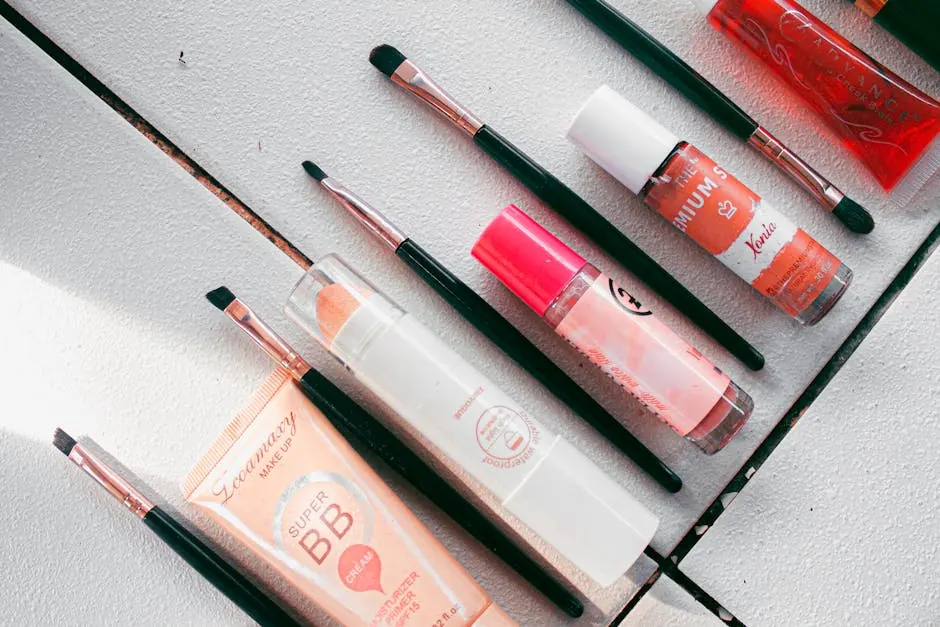
K-beauty — Korean cosmetic and skincare culture as a global retail category — anchors a meaningful share of the Hong Kong visitor's shopping list, and Seoul remains the canonical sourcing city. The Olive Young chain is the dependable mid-tier, with the higher Sulwhasoo and Whoo registers at Shinsegae and Galleria. Important: not every brand in Olive Young is Korean-manufactured — read the label. The duty-free arithmetic favours airport collection over street-retail purchase on most premium lines. See also: Olive Young, Duty-Free.
KakaoTalk
KakaoTalk — the dominant Korean messaging application, with roughly 88 per cent domestic penetration — is, for the Hong Kong reader, the Korean WhatsApp equivalent. Most Seoul clinics, hotels, and serviced residences communicate through Kakao rather than email or SMS. The application supports voice, video, and document share; the channel feature is widely used by clinics for appointment-confirmation broadcasts. Tip: download before arrival and link to a working number. See also: Naver, KakaoMap.
Kimchi
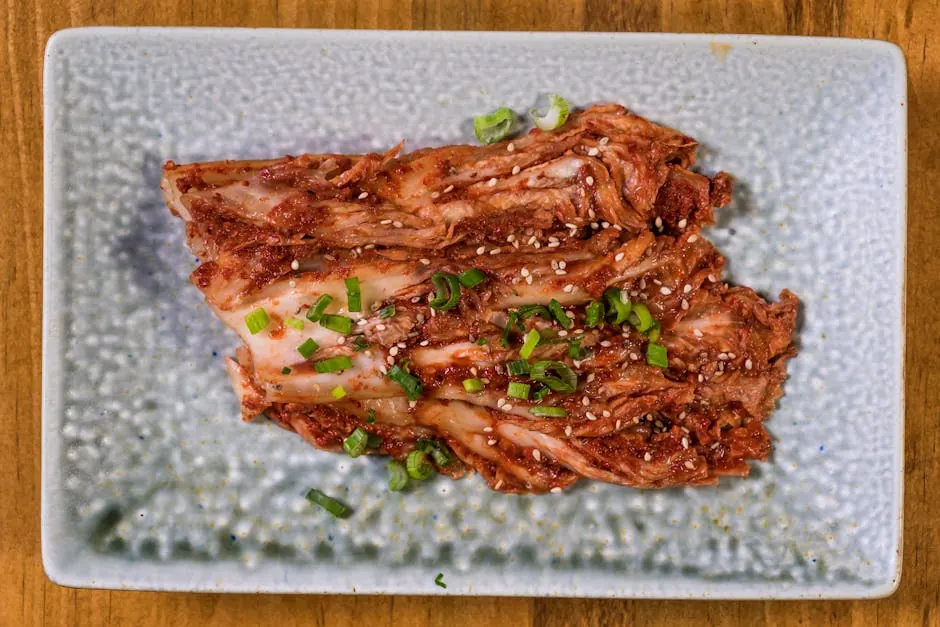
Kimchi — fermented vegetables, most commonly napa cabbage with chilli, garlic, ginger, and salted shrimp — is the cornerstone of the Korean meal, served at virtually every restaurant table. The household varieties number in the hundreds; the canonical winter cabbage baechu kimchi is the one most Hong Kong visitors will encounter first. The fermentation cadence, the spice level, and the seasonal gimjang tradition are all part of the cultural register. See also: Banchan, Gimjang.
KTX
KTX — Korea Train Express, the high-speed rail link — runs from Seoul Station to Busan in roughly two hours forty minutes, and to Gwangju, Daegu, and the southern provincial capitals on parallel lines. The pricing and cadence sit, for the Hong Kong reader, somewhere between the Hong Kong-Guangzhou XRL and the Tokaido Shinkansen — closer to Japan in seat quality, closer to China in price discipline. The Seoul Station booking counter accepts cards; the Korail mobile application is faster. See also: Seoul Station, Express Bus.
L-M
The L and M entries cover the Lotte department-store anchor, the metro line-numbering, the Myeongdong shopping core, and the Naver mapping tier that increasingly competes with KakaoMap.
Lotte World Tower
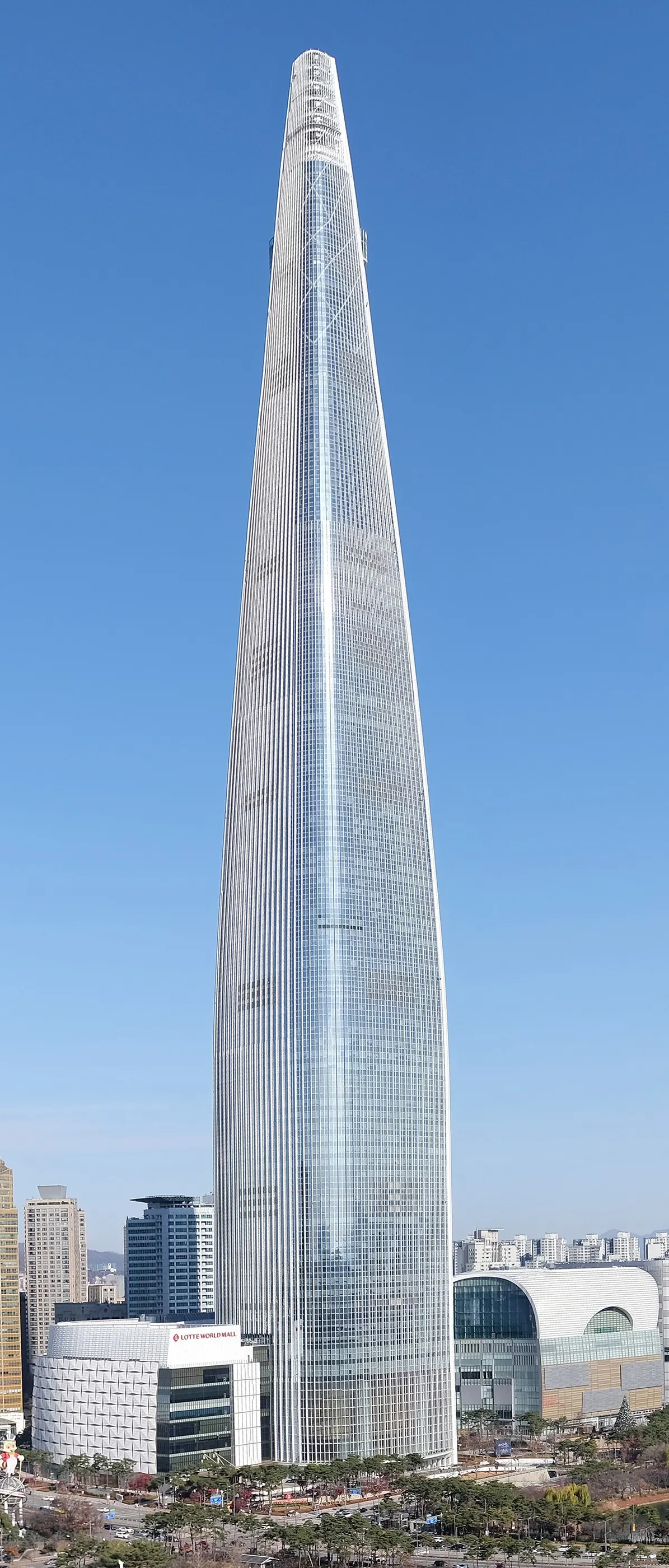
Lotte World Tower — at 555 metres the tallest building in Korea, sitting on the Jamsil cluster east of central Gangnam — anchors the Lotte Department Store, the Signiel hotel, and the Seoul Sky observation deck on the 117th-118th floors. For the Hong Kong reader the silhouette reads closer to ICC than to IFC, and the Sky observation deck rivals Sky100 in cadence and pricing. The tower sits directly on Metro Line 2 and 8 at Jamsil Station. See also: Signiel, Jamsil.
Metro (Subway)
The Seoul Metro — twenty-three lines, over three hundred stations, the world's third-busiest urban rail network by ridership — is the operational spine of any central-Seoul itinerary, denser than the Hong Kong MTR and operating at slightly lower fares. The T-Money card works across all lines and most buses. Tip: download the Subway Korea or KakaoMetro application for routing in English; the in-station signage is bilingual but the trip-planning interface is the faster workflow. See also: T-Money, KakaoMap.
Myeongdong
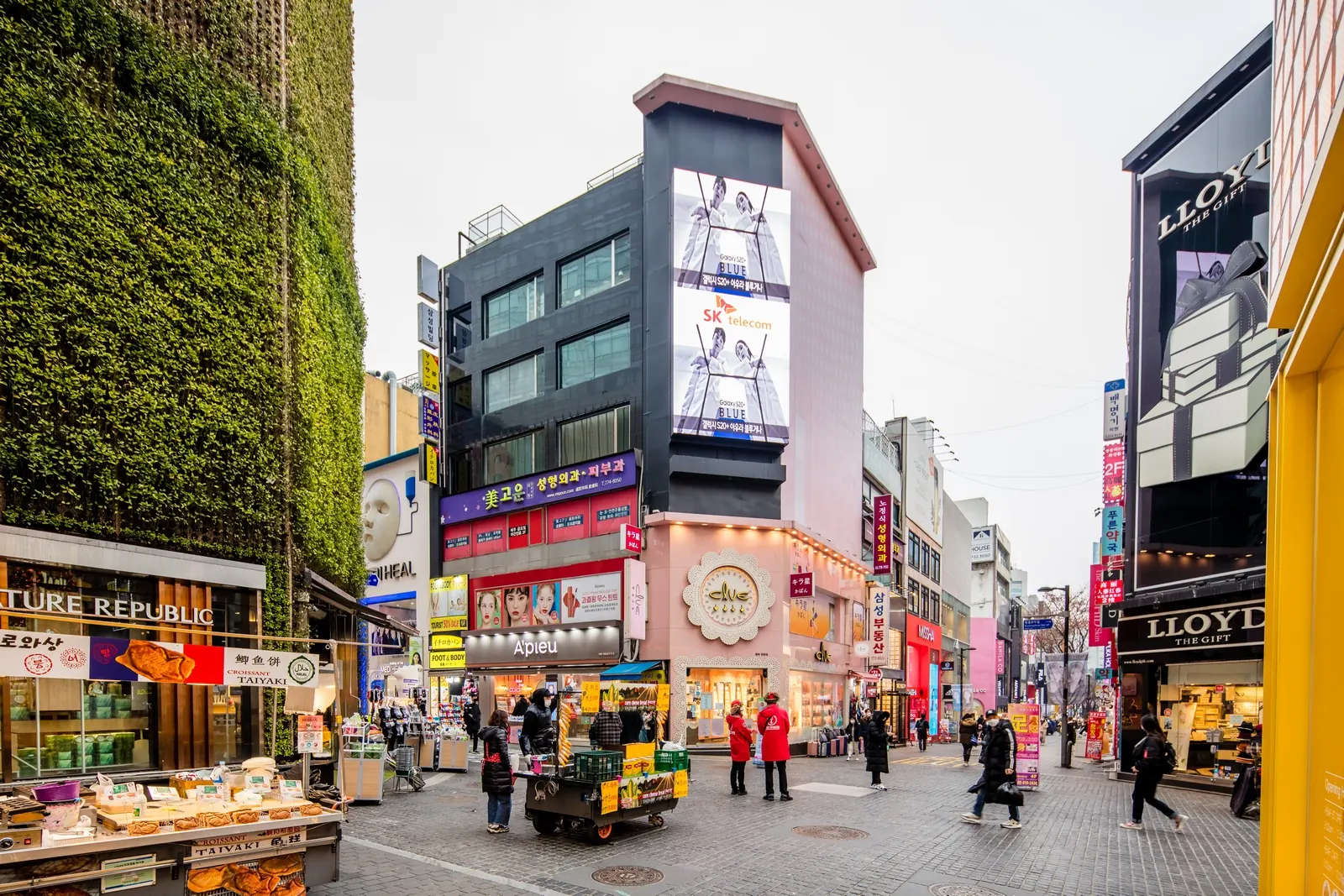
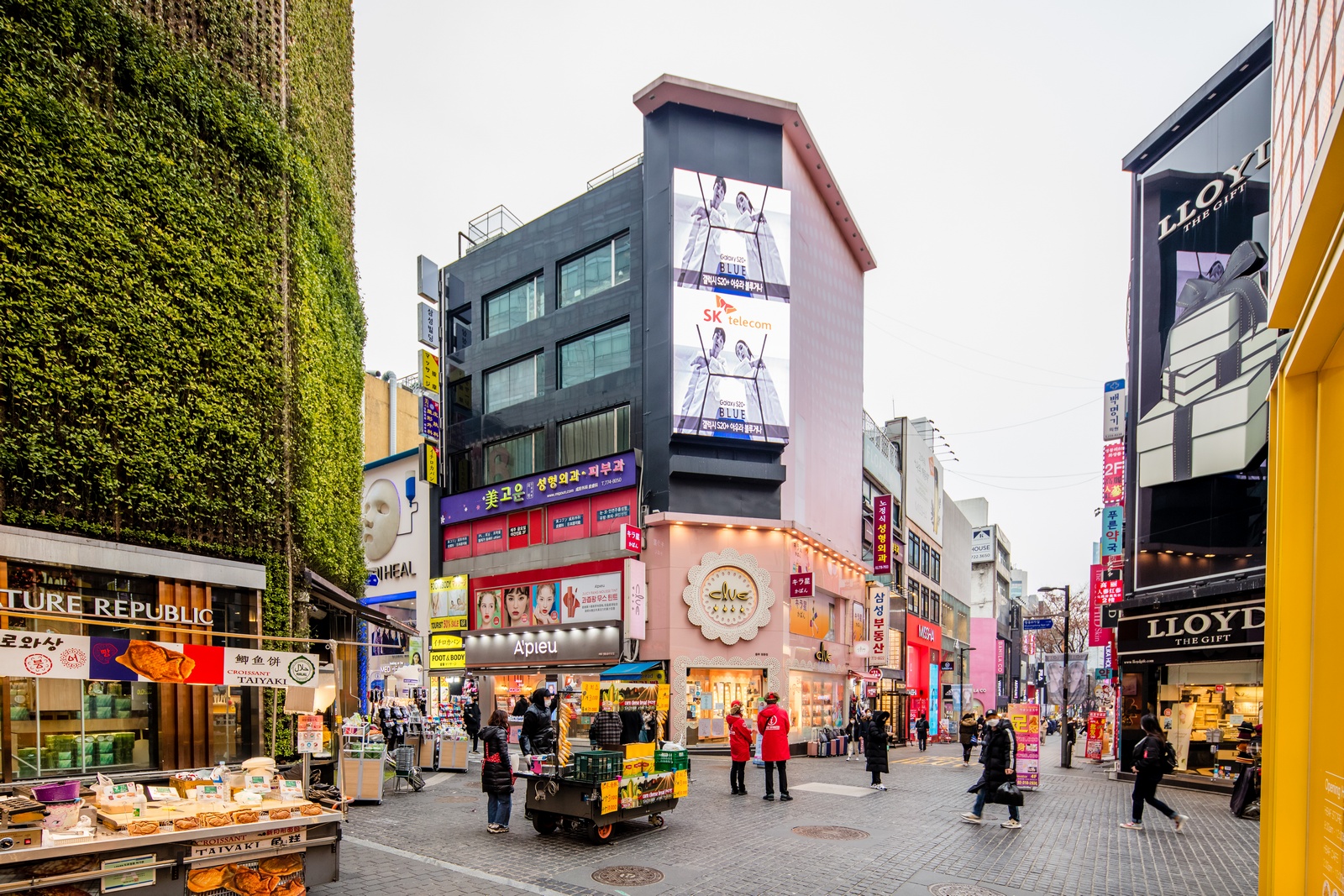
Myeongdong — the central retail district north of the river, anchored on Myeongdong Cathedral and the Lotte Department Store main store — is the city's primary tourist-shopping zone, densest with cosmetics flagships, casual fashion, and the tax-refund desks that anchor most visitor circuits. For the Hong Kong reader Myeongdong reads as a Causeway Bay analogue, narrower and more retail-concentrated. The street-food cluster runs from late afternoon. See also: Tax Refund, Lotte.
MERIT (Tax Refund Threshold)
Korean tax-refund — formally the Tax Refund for Foreigners scheme — operates on a 30,000 KRW minimum-purchase threshold per receipt at participating retailers, with refund desks at ICN, GMP, and most central department stores. The refund covers the 10 per cent VAT and a portion of the consumption tax. For the Hong Kong reader the cadence is familiar from the equivalent Japanese and Singaporean schemes. Important: keep the receipts and the unopened goods until the airport refund counter. See also: Duty-Free, Lotte.
Mukbang
Mukbang — eating broadcast, the Korean live-stream genre in which a host eats large quantities of food on camera — is the cultural register that, alongside K-pop and K-drama, has shaped the international image of Korean food culture. The Hong Kong reader will recognise the format from the local food vlogger tradition, though the Korean version runs at a longer duration and stricter aesthetic. The genre's influence shows in restaurant plating and portion theatre. See also: K-Drama, Cafe Culture.
N-O
The N and O entries cover the Naver navigation tier, the Noraebang singing-room category, the Olive Young retail anchor, and the Ondol heated-floor tradition that defines the hanok stay.
Naver Map
Naver Map — the dominant Korean digital-map application, alongside KakaoMap — is, for the Hong Kong reader, the Korean answer to Google Maps, and substantially more accurate inside Korea than Google's own product. The application supports English-language search, full transit routing, and live bus arrival times. Tip: many Seoul restaurants and clinics list on Naver but not on Google; if a search returns no results, switch applications. See also: KakaoMap, Address Format.
Noraebang
Noraebang — singing room, the Korean private karaoke booth — is the canonical Seoul nightlife unit, distinct from the Japanese karaoke-box tradition in pricing discipline and the Hong Kong KTV register in social register. Booths run from sixty minutes upward at roughly 20,000-40,000 KRW per hour for a small room. The Coin Noraebang variant, paid by the song, is the budget late-evening option. The cadence is louder than the Hong Kong equivalent and more song-rotation-driven. See also: Hongdae, Gangnam Station.
Olive Young
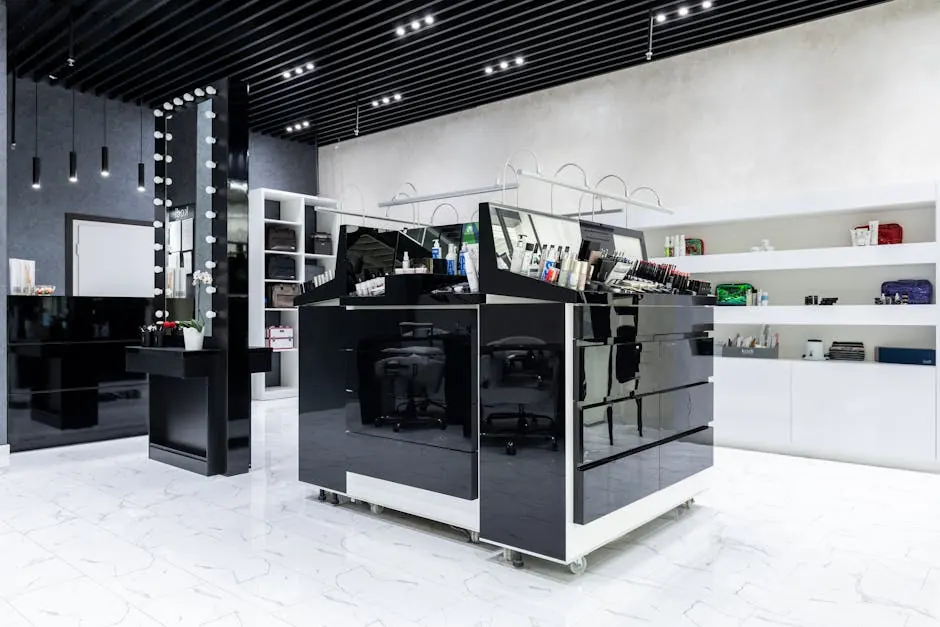
Olive Young — the dominant Korean health-and-beauty retail chain, with over 1,300 stores nationally — is, for the Hong Kong K-beauty visitor, the canonical sourcing destination at the mid-tier. The flagship Myeongdong and Gangnam Station branches carry the deepest stock; the application and website operate a same-day delivery option in central Seoul. Important: the Olive Young pricing routinely undercuts the Hong Kong Sasa equivalent on Korean-manufactured lines. See also: K-Beauty, Tax Refund.
Ondol
Ondol — the traditional Korean underfloor heating system, originally fired by wood-fuelled flue and now uniformly electric or hot-water — defines the hanok-stay floor experience and remains standard in modern Korean apartments. The system heats the floor itself rather than the room air, producing a warmer-feet, cooler-head register that the Hong Kong reader will find unfamiliar in the first hour and welcome by the second. The cultural expectation is to remove shoes at the entrance. See also: Hanok Stay, Apartment Hotel.
P-S
The P through S entries cover the practical anchors — pharmacy walk-in protocol, the Seoul Station rail hub, soju as the dominant social spirit, and the Seongsu third-wave creative district that has, in the last five years, become the city's most-watched neighbourhood.
Pharmacy (Yakguk)
Korean pharmacies — yakguk — are walk-in, over-the-counter retail with green cross signage, distinct from the convenience-store layer in that they dispense prescription medication and provide informal pharmacist consultation. For the Hong Kong reader the layer is closer to the Manning's pharmacy counter than to a standalone Watsons. Important: the pharmacist may not speak English; the Naver Papago application handles the translation cleanly. Most central-Seoul pharmacies close by 21:00 — for after-hours, the convenience store carries paracetamol and basic gastro remedies. See also: Convenience Store, Papago.
Seongsu-dong
Seongsu-dong — the converted-industrial district east of the river, anchored on Seongsu Station Lines 2 and the Bundang Line — is the city's third-wave coffee, gallery, and concept-retail centre, the Seoul answer to a Brooklyn DUMBO or a Hong Kong PMQ-Tai Kwun corridor. The district has, in the last five years, drawn the more curated cafe brands, the rented-warehouse pop-ups, and the Apple Seoul flagship. For the Hong Kong reader Seongsu reads as the city's most legible recovery-week walking neighbourhood. See also: Cafe Culture, Tongin Market.
Seoul Station
Seoul Station — the central rail hub, anchoring KTX, AREX, Metro Lines 1 and 4, and the Gyeongui-Jungang suburban line — is the principal arrival point for the airport-to-city transit and the departure point for southern-province intercity travel. The station building hosts a Lotte Mart, a department-store annexe, and the city's most reliable Western-brand hotel cluster within five hundred metres. For the Hong Kong reader the layout reads as a denser Hung Hom Station hybrid. See also: AREX, KTX.
Soju
Soju — distilled rice or grain spirit, traditionally roughly 17 to 20 per cent alcohol, served chilled in 360-millilitre green bottles — is the dominant social spirit of the Korean meal, drunk in shot glasses in rotation around the table. The brands Chamisul and Chum-Churum anchor the mass-market tier; the artisanal craft-soju category has expanded sharply in the last decade. For the Hong Kong reader the social register is closer to baijiu in toasting cadence and closer to sake in alcohol level. Tip: drink water between rounds. See also: Etiquette, Chimaek.
Subway Etiquette
Seoul Metro etiquette runs to a stricter register than the Hong Kong MTR — silent phone-calls on trains, designated priority seating left empty even at peak crowding, no eating or drinking within carriages. The first and last carriages are typically reserved for women during late-evening hours. For the Hong Kong reader the cadence is more Tokyo than Hong Kong, and rewards quiet observation. The seat-yielding to elderly passengers is enforced socially, not by signage. See also: Metro, Bus.
T-Z
The T through Z entries close the glossary — the T-Money card, the Yongsan-Itaewon hospitality corridor, the Yeouido financial-and-park district, and the closing logistical terms that frame the visit's last hours.
T-Money
T-Money is the rechargeable transit card — sold at any convenience store for 4,000 KRW empty, topped up at station kiosks or counter — that operates across Seoul Metro, city buses, and most taxis. The Hong Kong reader will recognise it as the Korean Octopus equivalent, with the additional convenience-store retail use that Octopus also offers. Important: the card is not refunded at the airport at full value — keep a small balance for the next visit, or use it down before departure. See also: Metro, Bus.
Taxi (Kakao T)
Seoul taxis — orange standard, black deluxe, white international — are hailed at street level or via the Kakao T application, the Korean Uber-equivalent that anchors most visitor workflows. The pricing sits roughly forty per cent below the Hong Kong red-taxi metered fare for an equivalent distance. Tip: the international (white) tier carries English-speaking drivers at a roughly thirty per cent premium and is worth booking for clinic transfers if the Korean coordinator has not arranged a sedan. See also: Kakao T, Coordinator.
Tax Refund
The Korean tax-refund scheme — described above under MERIT — operates at participating retailers on purchases above 30,000 KRW per receipt, refunded at ICN and GMP airport desks before customs. The refund covers VAT and a portion of the consumption tax. For the Hong Kong reader the cadence is familiar from the equivalent Japanese and Singaporean schemes. The Global Blue and Global Tax Free counters at ICN handle the bulk of the volume; queue length runs ten to thirty minutes at peak. See also: Duty-Free, ICN.
Tongin Market
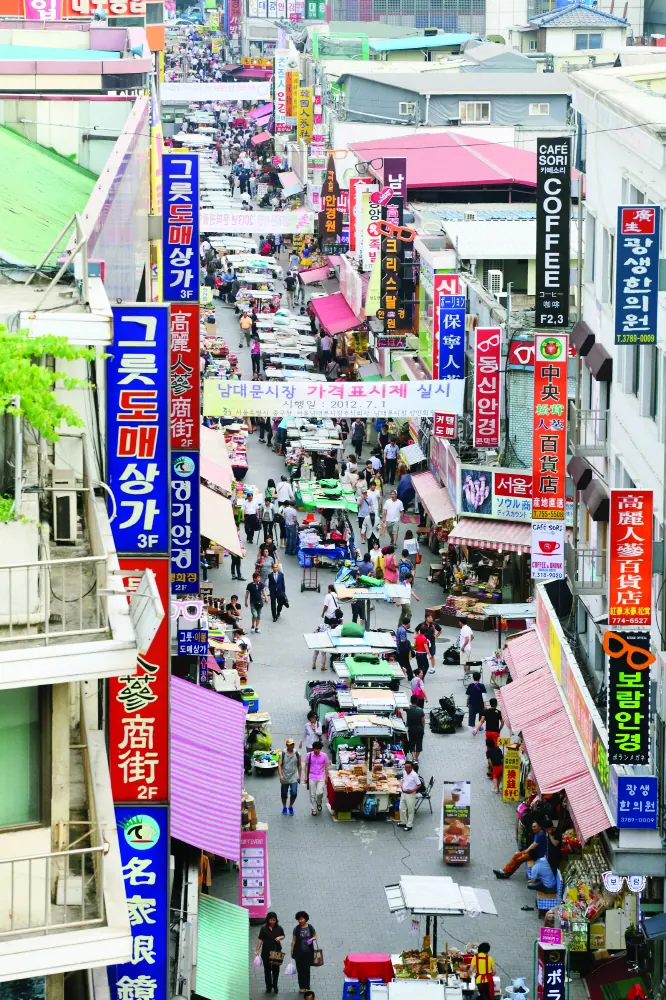
Tongin Market — the covered traditional market in Seochon, west of Gyeongbokgung — operates a dosirak coupon system in which visitors purchase a set of brass coins at the office and exchange them at participating stalls for portions of banchan, fried foods, and rice. The system reads, for the Hong Kong reader, as a curated cooked-food-centre wander with built-in portion-control. The market is the better lunch option for a Bukchon-Gyeongbokgung walking morning. See also: Bukchon, Banchan.
WeChat / WhatsApp Use
WeChat carries roughly half the share among Korean travel operators that it does among Mainland-Chinese counterparts; WhatsApp is uncommon. The dominant channel for clinic and hotel communication is KakaoTalk, secondarily SMS. For the Hong Kong reader operating across both Mainland Chinese and Korean trips, the workflow is to download Kakao before the Seoul leg and treat it as the primary channel. 呢個小細節好重要. See also: KakaoTalk, eSIM.
Yeouido
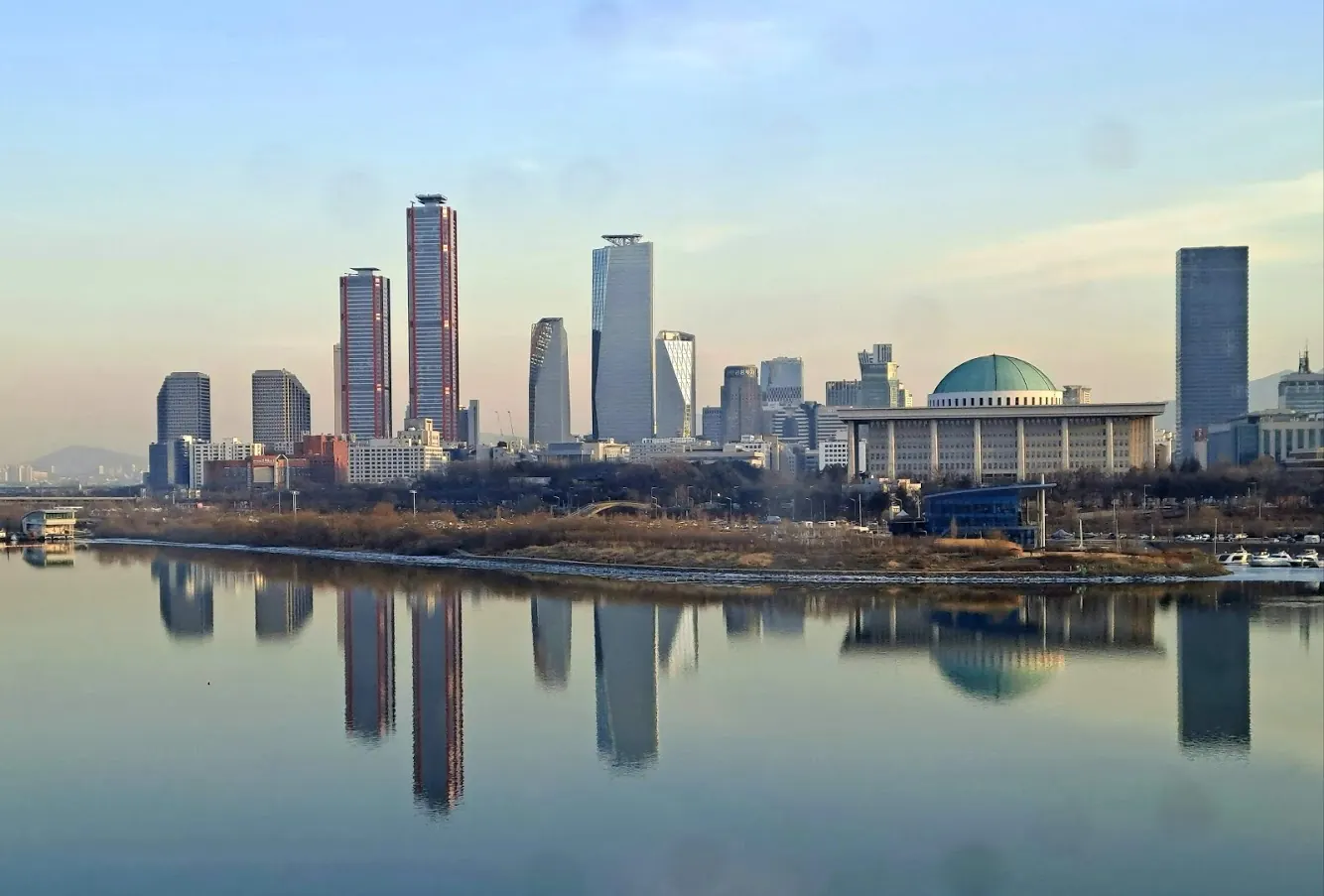
Yeouido — the financial-and-broadcast district on the Han River island, anchored on the National Assembly, the IFC mall, and the Conrad Seoul — is the city's secondary business core, distinct from Gangnam in tone and architecture. The Yeouido riverside park is the city's principal cherry-blossom corridor in early April, drawing weekday crowds. For the Hong Kong reader Yeouido reads as a quieter Central with stronger park programming. See also: Han River, Gangnam-gu.
Yongsan-Itaewon Corridor
The Yongsan-Itaewon corridor — anchored on Yongsan Station, the Hyatt Regency, and the Itaewon foreigner-facing district — is the city's most cosmopolitan hospitality strip, with the strongest English-language hotel and restaurant density. The corridor sits twenty minutes from Apgujeong by Line 6 and reads, for the Hong Kong reader, closer to a Wan Chai-Causeway Bay hybrid in tone. The Hannam-dong sub-district immediately east holds the more refined hotels and the Leeum Museum. See also: Itaewon, Hannam-dong.