A Reader's Seoul
Rainy Season in Gangnam: An Indoor Editor's Itinerary
A monsoon-week plan for the Gangnam traveller — underground concourses, museum hours, department-store food floors, and the slow indoor afternoons the rain rewards.
The Korean monsoon — jangma, in the local idiom — settles over Seoul somewhere between the last week of June and the second week of July, and it stays for roughly three weeks. The brochures rarely lead with this. They prefer the cherry-blossom photographs and the autumn maples, and one understands why; the rain is harder to romanticise. Yet there is a specific pleasure in a Gangnam rainy week, if one builds the trip around it rather than against it. The district is, in its bones, an indoor city — vast underground concourses connecting metro stations to department-store basements, glass-walled museum lobbies, bookshop floors that run for half a city block. 落雨天最啱嘆嘢食, my mother used to say in the Causeway Bay arcades of my childhood, and the principle holds here. This itinerary is for the traveller who has already done Gangnam in spring, and who wants to come back in July and stay dry.
The underground city: Gangnam Station to COEX without surfacing
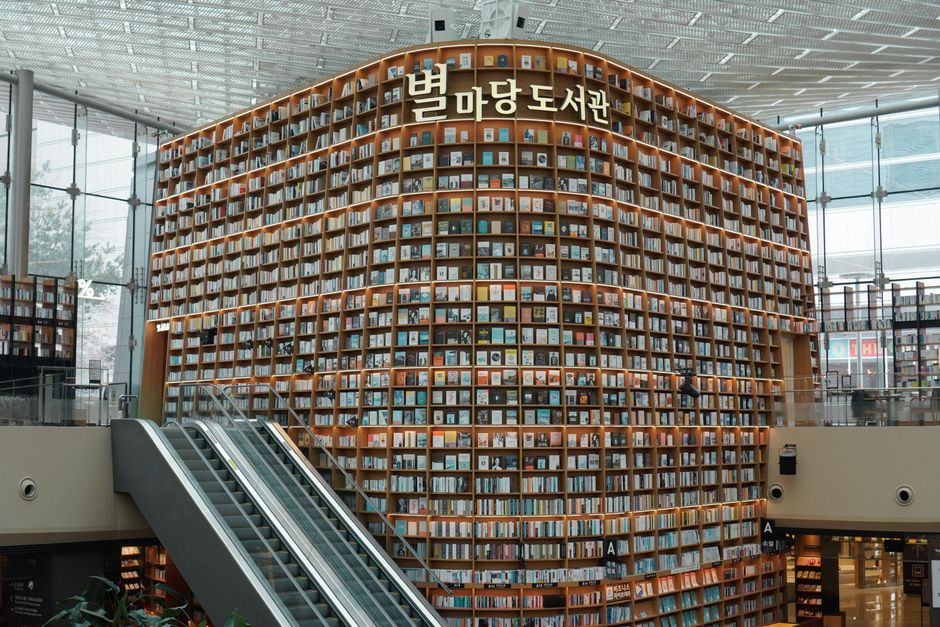
The Gangnam underground network is the architectural answer to monsoon week. Three connected systems anchor the district — the Gangnam Station concourse beneath Line 2, the Express Bus Terminal Goto Mall further west, and the COEX Mall complex under Samseong Station — and on a rain-heavy afternoon one can move between them with a single dry jacket and no umbrella. Goto Mall, in particular, is the long indoor walk the traveller does not expect; it runs for some six hundred metres, holds roughly six hundred small shops, and reads less like a mall than like a covered market lane. The Gangnam Station concourse — busier, glossier, more international — connects directly to the basements of Hyundai Department Store and the bookshop floor at Kyobo. COEX is the third anchor, and its Starfield Library is worth the detour even on a clear day. The right approach, on a wet morning, is to enter the underground at one's hotel-adjacent station, walk for two hours through the network, and emerge for lunch only when one chooses to. 呢度真係唔使戴遮, a Hong Kong friend texted me on her third July visit. She had walked from Sinsa to Samseong without surfacing once.

Department-store food halls: where Gangnam eats when it rains
The department-store food hall — the depachika tradition Korea has refined into something more luxurious than its Tokyo origin — is the indoor lunch the rainy itinerary depends on. Three floors deserve mention. The basement at Hyundai Apgujeong holds, in a single concourse, the most considered selection of pastries, prepared meals, and seasonal fruit in the southern half of the city; the dessert counters alone justify ninety minutes. Galleria's two floors in Apgujeong, connected by an internal corridor, stretch the format toward the artisanal — small-batch ferments, regional kimchi from Jeolla, a tea counter that knows what it is doing. Shinsegae's Gangnam branch, beneath the Express Bus Terminal, runs broader and more practical; one comes here to stock the suite as much as to eat. The pacing question — and this matters — is restraint. A single coffee, two small purchases, one sit-down lunch at the in-store counter is the right rhythm for a single visit. The grocery floor rewards a return rather than a marathon.

Museum hours: Leeum, the Hermès Maison, and the smaller rooms
Museums hold a Gangnam rainy afternoon better than most district anchors. Leeum Samsung Museum of Art in Hannam — a fifteen-minute taxi from Apgujeong — is the obvious choice; the contemporary wing alone justifies two hours, the Korean traditional collection another, and the building itself, designed jointly by Rem Koolhaas, Mario Botta, and Jean Nouvel, is the sort of architectural pause the weather argues for. Smaller rooms reward the second visit. Maison Hermès Dosan Park is technically a flagship boutique, but the third-floor gallery space and the ground-floor cafe run as a quiet cultural anchor for the Apgujeong-Sinsa lane. The Horim Museum further north holds a respectable Korean ceramics collection in two compact floors. Songeun Art Space in Cheongdam, by Herzog & de Meuron, programmes contemporary shows that turn over every six weeks. None of these requires a full day. The rainy-week strategy is to visit two on one afternoon, lunch indoors between them, and leave time for the cafe afterwards.
The bookshop afternoon: Kyobo, Arc.N.Book, and the Starfield Library
Bookshops are the third anchor of an indoor week, and Gangnam holds three at meaningfully different scales. Kyobo Bookshop's Gangnam branch — beneath the Sinnonhyeon intersection, accessible via the underground concourse — runs to two floors and stocks the broadest English-language selection in the southern half of the city. The pacing here is gentle; one can sit at the floor's central reading bench for an hour without a purchase, and the cafe at the back is the kind of room one writes in. Arc.N.Book at the Express Bus Terminal is the smaller, more curated counterpart — a single floor, design-led, a tighter selection of art and architecture monographs. The Starfield Library at COEX is, strictly, a public reading space rather than a bookshop, and its photogenic two-storey shelves draw the heaviest crowds; the trick is to visit on a weekday between three and five, when the school groups have left and the late-afternoon light through the skylight is at its quietest. None of the three requires a reservation. All three reward two hours; one or two among them, on a single rainy day, is the right number.
Spas, hanjeungmak, and the indoor wellness afternoon
The Korean indoor wellness tradition — the hanjeungmak sauna, the jjimjilbang communal bath house, the contemporary spa — earns its full justification during jangma. Three approaches are worth noting. The traditional jjimjilbang format — communal baths, multiple sauna rooms, sleep halls — runs at every price tier in Gangnam, from the no-frills neighbourhood floor to the full-tier resort version above the COEX complex. The hotel spa format runs more discreet; the spa floors at the Park Hyatt, the Andaz, and the JW Marriott in Banpo each hold a small Korean sauna circuit, a steam room, and a cold pool, and one can use them on a half-day pass without a guest reservation in some cases. The third format — the contemporary day spa — sits between the two; one books a half-day package, takes the sauna, the cold plunge, and a treatment, and leaves four hours later more reset than any indoor museum hour can manage. The rainy week is when this register reads as essential rather than optional.
Late afternoon to evening: cafes, cocktail rooms, and dinner without an umbrella
By six in the evening, after a museum hour and a spa stretch, the rainy day asks for a cafe and a dinner one can reach without surfacing. The lanes around Dosan Park hold a cluster of small upstairs cafes that read better on a wet evening than on a sunny one — the rain on the windows, the room dim, a single espresso between the spa and the dinner reservation. The cocktail rooms come after. Le Chamber in Cheongdam, Alice in Sinsa, the small bar inside the Andaz lobby — each runs on the speakeasy register, each holds a quiet seat for the early hour, and each is reachable by a five-minute taxi rather than a fifteen-minute walk. Dinner on a rainy evening in Gangnam suits the indoor-rooted formats best: a barbecue room with proper ventilation, a kaiseki-influenced Korean tasting menu, a small soybean-paste stew restaurant near the hotel. The avenue at half past nine, in the rain, is its own kind of beautiful — slick paving, lit storefronts, the towers reading darker than they do on a clear night. One walks the last block back to the hotel, and the day reads as full without ever having been hurried.
Practical notes: dates, weather, hotels, the umbrella question
Jangma runs, in most years, from the third week of June through the second week of July; the heaviest rainfall sits in the first ten days of July, and the season tapers into a hot, humid August. Daytime temperatures during the rainy weeks hold between twenty-three and twenty-eight degrees Celsius, with humidity at eighty per cent or higher; nights stay warm. A light rain jacket is preferable to an umbrella for the underground walks — the umbrella becomes baggage the moment one enters a department store. Hotels in southern Gangnam suit this itinerary best, and the underground-adjacent ones suit it best of all; the JW Marriott in Banpo, the Park Hyatt at Samseong Station, and the Andaz in Apgujeong each connect to the underground network within a five-minute covered walk. Public transport runs without disruption in any but the heaviest typhoon week, and a T-money card covers everything. Two pragmatic notes — the city's sewer pumps cope well with sustained rain but struggle with sudden cloudbursts, so flash flooding in low-lying lanes is real for a few hours each season; and laundry-bag mildew is the souvenir no one talks about, so a small mesh wash bag in the case is wiser than it sounds.
Frequently asked questions
When does the Korean monsoon actually run?
Most years, the third week of June through the second week of July — roughly three weeks, with the heaviest rain in the first ten days of July. August is hot and humid rather than rainy. The Korea Meteorological Administration publishes the official onset and end each year, but planning a trip for the first ten days of July is the safest approximation if one wants the indoor itinerary at full strength.
Is Gangnam genuinely walkable underground in the rain?
Yes — and more than the brochures suggest. The Gangnam Station concourse, the Express Bus Terminal Goto Mall, and the COEX Mall complex form a connected indoor network that runs for several kilometres in aggregate. Most major southern Gangnam hotels are within a five-minute covered walk of one of the three. One can move between the network's anchors without surfacing, and an afternoon's worth of shopping, eating, and reading is genuinely possible without an umbrella.
Do I need to book museum tickets in advance during monsoon weeks?
Leeum Samsung Museum requires a same-day timed entry — bookable online the morning of the visit, or via the museum's app. Walk-in tickets exist but are not guaranteed on weekends. The smaller rooms — Maison Hermès Dosan Park, the Horim, Songeun — accept walk-ins comfortably, and the rainy weeks are quieter at all of them than the autumn months.
Are spas and jjimjilbang worth visiting in summer?
Particularly, yes. The Korean wellness tradition is built for humidity rather than against it; the indoor temperature differential between a sauna and a cold pool is more reset, in summer, than the equivalent in any milder season. The hotel spa format, the contemporary day spa, and the traditional jjimjilbang each suit a different mood, and a half-day at any of them reads as the most useful single anchor of a rainy week.
What should I pack for monsoon-week Gangnam?
A light rain jacket — preferred over an umbrella for the underground walks — and shoes that handle wet pavement. Two pairs of walking shoes is wiser than one, since drying takes longer in the humidity. A small mesh laundry bag prevents the mildew problem no one warns travellers about. For dinner rooms in Cheongdam, smart-casual rather than formal works; the avenue dresses well but does not punish an unironed shirt during the rainy weeks.
Is it safe to be in Seoul during a typhoon?
Generally yes — the city is well-prepared, the metro continues to run, and most typhoons pass north or weaken before reaching Seoul directly. The advisory the traveller should follow is the Korea Meteorological Administration's three-day forecast, available in English; flash flooding in low-lying lanes is the realistic risk rather than wind damage in central Gangnam. Hotels post advisories at reception during heavier weather windows.
How does the rainy season compare to August?
Rainy season is wetter but cooler, and the indoor itinerary reads as the central pleasure. August is hotter — daytime temperatures reach the low thirties — and humid, but with sunnier afternoons and less rain. For the indoor-leaning traveller, the rainy weeks are arguably the better choice; for a Han River evening in shorts, August holds the advantage. The trip-builder's question is which mood one is travelling for.
Is the rainy season suitable for a recovery-focused travel pace?
Yes, and unusually well-suited. The indoor structure of the itinerary — underground walks, museum hours, spa afternoons, department-store food floors — runs gentler on a body than the outdoor-anchored spring and autumn versions. Total walking sits closer to four to six hours across four days; hotel time runs longer; and the absence of bright sun is itself a recovery feature for travellers managing a treatment-adjacent calendar.