A Reader's Seoul
A Late Spring Long Weekend in Gangnam
Four nights, five days, gentle pacing — cherry blossoms after Yeouido, Han River dawns, and the cafe lanes between Apgujeong and Cheongdam.
Late spring in Gangnam reads, on first impression, as a quieter season than the brochures suggest. The cherry blossoms peak earlier than most travellers expect — the second week of April in most years — and by the time the long-weekend traveller arrives, the trees along Yeouido are already past. What remains, in the back lanes of Apgujeong and along the Han River promenade on the southern side, is a softer, slower bloom: the late-flowering cherries, the magnolias, the early azaleas. The weather settles by the end of the third week. One walks more, one sits more, and the avenue between Sinsa and Cheongdam shows a different temperament than it does in summer. This itinerary is built for that window — four nights, five days, gentle pacing, with the kinds of rooms one would write a friend about afterwards.
Day one: arrive, settle, and a slow first walk south of the river
Day one is for the room. Most international flights arriving from Hong Kong, Taipei, Tokyo, or Singapore land at Incheon between mid-morning and early afternoon — the airport limousine to southern Gangnam runs roughly seventy minutes, the AREX train via Seoul Station closer to ninety. Whichever route one chooses, one arrives at the hotel between two and four. I would unpack slowly, take the lift down for an early espresso, and walk — without an itinerary — for forty minutes through the back streets behind one's hotel. The walk is the first piece of pacing the trip is built on. From most southern Gangnam hotels, one is fifteen minutes on foot from the Han River promenade. I would aim there for the late-afternoon hour — the river is at its best between five and seven in late April, when the light softens but the air has not yet cooled. Dinner the first night should be small and close to the hotel. A bowl of noodles, a single glass of wine, and an early sleep. The trip properly begins on day two.
Day two: the Han River promenade, a temple morning, and an early dinner
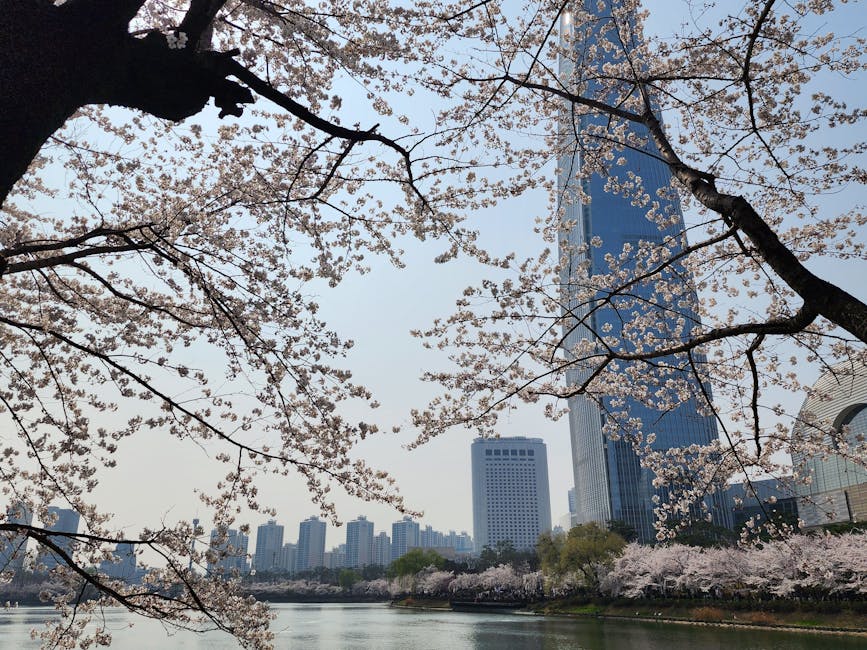
Day two is the slow day. I would begin with the Han River promenade on the Gangnam side — a thirty-minute walk, ideally before nine, when the path is held by joggers and dog-walkers rather than the late-morning crowds. The cherry blossoms along the southern bank, in late April, hold longer than the more famous trees on Yeouido; one walks past three or four small parks and a handful of riverside cafes that open by half past eight. Coffee at one of them, a bench facing the water, and the morning fills itself. From the river, a taxi south-east to Bongeunsa Temple takes ten minutes — and Bongeunsa is, in my reading, the right midday anchor for a Gangnam itinerary in spring. The temple grounds hold both the late cherry blossoms and the early azaleas; the main hall is open, the side halls quieter, and the small tea house behind the bell pavilion serves a hojicha that is worth the visit alone. Two hours at Bongeunsa, lunch at a soybean-paste stew restaurant nearby, and an afternoon nap at the hotel. Dinner — early, by half past six — at a small Korean restaurant in Apgujeong. The day closes itself.
Day three: the cafe afternoon, the museum hour, and a late dinner
Day three is the cafe day. I would build the morning slowly — breakfast in the room, a long shower, the first walk by ten — and aim the late morning at the lanes around Dosan Park. The Dosan Park area, in late April, is the most considered cafe district in Gangnam; the buildings are low, the lanes narrow, and the late-spring light makes the whole quarter read as a different city than it does in summer. Three or four cafes is the right number — a small espresso bar to open, a celebrated room to walk through, and one of the smaller upstairs rooms to actually sit in for an hour. Lunch is unstructured — a bakery sandwich, perhaps, or one of the small restaurants on the lane. From Dosan Park, an afternoon at the Leeum Samsung Museum of Art in Hannam takes a short taxi; the contemporary wing alone is worth ninety minutes, and the building itself, by Rem Koolhaas and Mario Botta, is the kind of architectural pause that anchors the trip. Dinner on day three should shift register — a tasting menu in Cheongdam, a quiet wine bar, or a kaiseki-influenced Korean dining room. One eats later, one walks home along Apgujeong-ro, and the avenue at half past nine is at its most elegant.
Day four: the morning market, the long afternoon, the Han River dusk
Day four is the day to widen the radius. I would begin with a premium grocery floor — SSG Food Market in Cheongdam, ideally before noon — and build the rest of the day from there. An hour on the food floor, a small purchase or two for the suite, and a coffee on the way out. From Cheongdam, a thirty-minute taxi north-east takes one to Seonjeongneung, the royal tombs in the middle of the district — a quiet half-day on its own. The grounds are at their best in late April; the path through the burial mounds runs under mature trees, the air is cooler than the avenue, and one walks for an hour without seeing a phone screen. Lunch nearby, an afternoon coffee in the hotel, and dinner — this is the one I would mark in the diary — at a Korean barbecue room in Garosu-gil that takes reservations. Dusk on the fourth night is for the Han River again. One can walk south from Sinsa to the riverside in twenty minutes, sit on a bench between the cherry trees, and watch the city light come on. The evening reads, on a quiet weekday in late April, as the most undramatic kind of pleasure.
Day five: the close, the slow morning, and the airport
Day five depends on the flight. The most useful pacing — for a long-weekend traveller — is an evening departure, which leaves the morning and most of the afternoon for a slow close. I would build the morning as a single long walk: from the hotel, north through Sinsa Garosu-gil, into the lanes behind it, past the smaller boutiques and the second-tier cafes, and back south through Apgujeong. Lunch should be small and Korean — a bowl of mul naengmyeon, a bibimbap, the kind of meal one will think about on the flight home. The afternoon is a single bookshop or gallery, and a final coffee in the hotel lounge before the airport limousine. The seventy-minute drive to Incheon, in late afternoon, is not unpleasant; one watches the city give way to the Han estuary, and the trip closes itself the way a good trip should. The whole itinerary runs about six to eight hours of walking spread across four full days — the right cadence, in my reading, for a late-spring long weekend, and a trip one would book again.
Practical notes: weather, hotels, transport, the cadence question
Late April through mid-May is the window the itinerary is built for. Daytime temperatures sit between fifteen and twenty-two degrees Celsius; nights cool to around ten. A light jacket is essential for the Han River mornings and the temple visit; layers — rather than a heavy coat — work for the cafe afternoons. Hotels in southern Gangnam suit this itinerary best — the Mondrian, the Glad in Yeoksam, the Andaz in Apgujeong — and any of them put the Han River, Bongeunsa, Dosan Park, and Cheongdam within fifteen minutes by taxi. Public transport is excellent; the Seoul Metro lines 3, 7, 9, and the Bundang line all run through Gangnam, and a single T-money card covers everything. The taxi alternative is generous — an in-district fare runs roughly five to eight US dollars per ride. The cadence question — and this matters — is one of restraint. Four full days in Gangnam can be filled with twice the agenda this itinerary holds, and one would arrive home tired. The point of a late-spring long weekend is that one does not. Three to four anchored moments per day — a walk, a temple or museum, a cafe stretch, a dinner — and the rest is allowed to remain unplanned.
Frequently asked questions
When exactly do the cherry blossoms peak in Seoul?
In most years, the first or second week of April. By late April — the window this itinerary is built for — Yeouido is past, but the back lanes of Apgujeong, the southern Han River promenade, and the temple grounds at Bongeunsa hold their late-flowering cherries and early azaleas through the third week. The trade is fewer crowds for a softer bloom — a fair trade, in my reading.
Is four nights long enough for a Gangnam-focused trip?
Yes, comfortably. The itinerary above fills four full days at a gentle pace, with room left for unplanned hours and the kind of slow walking the district rewards. Three nights is workable but tighter; five nights begins to repeat itself unless one widens the radius to Seongsu or Hannam, which is a different itinerary.
Should one rent a car or rely on taxis and the metro?
Taxis and the metro, without question. Driving in central Seoul is unpleasant, parking is expensive, and the metro covers Gangnam comprehensively. A T-money card, loaded once at the airport or any convenience store, runs the entire itinerary. Taxis fill the gaps — a typical in-district fare sits between five and eight US dollars, and English-speaking drivers are more common in southern Gangnam than elsewhere.
What is the best single morning of the trip?
Day two — the Han River promenade before nine, followed by Bongeunsa by midday. The combination of the river light, the late cherries, and the temple grounds in spring is the most distinctly Gangnam morning the season offers, and it sets the cadence for the rest of the trip. Day four runs it close; day three is the most urban; day one and day five are deliberately shorter.
Where should one stay in Gangnam for this itinerary?
Southern Gangnam, broadly — Apgujeong, Cheongdam, or Yeoksam. The hotels I would consider, in alphabetical order, are the Andaz in Apgujeong, the Glad in Yeoksam, and the Mondrian in southern Gangnam. Each puts the Han River, Bongeunsa, Dosan Park, and the Cheongdam grocery floors within a fifteen-minute taxi or a thirty-minute walk.
Is the itinerary suitable for a recovery-focused travel pace?
Yes — and this matters. The pacing is built around three to four anchored moments per day, with extended hotel time and gentle walks rather than schedule-heavy days. The total walking runs about six to eight hours spread across four days. One can compress to a quieter version by skipping day three's museum or day four's barbecue dinner, and the trip remains coherent.
What should one pack for a late-spring Gangnam trip?
Layers, a light jacket, and walking shoes that will manage two to three hours on flat pavement. A small umbrella is wise — late spring brings occasional showers, particularly in early May. For the dinner rooms in Cheongdam, smart-casual rather than formal; the avenue dresses well but not formally. A passport for tax-free shopping at the grocery floors closes the list.