Travel & Culture
Dongdaemun After Hours: A Night Shopping Plan from Gangnam
A measured late-night route from a southern Seoul hotel to the DDP and the Dongdaemun shopping towers — taxi, edit, and the return before two.
Dongdaemun is the only neighbourhood in Seoul that fully reads at midnight — louder than at noon, more crowded at one in the morning than at one in the afternoon, lit the way Causeway Bay was lit before the gweilo tourists thinned. The wholesale shopping towers operate to dawn; the DDP — Zaha Hadid's metallic curve set into the eastern wall of the old fortress — keeps its rose garden open later than any building in Gangnam will. The transit from a southern Seoul hotel takes twenty-five minutes by taxi after eleven, and the return — and this matters — runs twenty after one.
Why Dongdaemun, and why specifically after eleven
Dongdaemun is the historic eastern gate of the old Joseon-era city wall and, since the 1960s, the central Seoul wholesale-and-retail garment district — a five-block perimeter of mid-rise shopping towers that operate, by tradition and by buyer cadence, from late evening to dawn. The towers are not a single mall. They are a collection of buildings — Doota, Migliore, Hello apM, Lotte Fitin, Maxtyle, several smaller buildings — each a vertical stack of small concession booths run on a wholesale clock that the day-tourist itinerary cannot read. What recommends a visit after eleven, rather than during the afternoon, is the actual register of the district. The afternoon Dongdaemun is the buyer-quiet half of the cycle — half-stocked, half-staffed, oriented toward the daylight foot traffic. The midnight Dongdaemun is the working district itself: lights are at full register, vendors are restocked, the Korean and Chinese wholesale buyers from the markets are at their tables, and the prices are cleaner because the staff are awake. The cadence is undramatic — there is no spectacle, no neon performance — but the energy is real, and the towers fill rather than thin. 夜行成衣街, a friend who used to source Hong Kong stalls put it; the night garment district. She had sourced from Mongkok for a decade, and recognised the rhythm immediately.

The Gangnam-to-Dongdaemun taxi: route, time, and what to ask the driver
From the better hotels in southern Gangnam — along Apgujeong-ro, Eonju-ro, or the Cheongdam quarter — the most reliable late-night route to Dongdaemun is by taxi rather than subway. The subway closes around midnight in either direction; the night bus network reaches the area but adds twenty minutes and a transfer; a taxi runs twenty-five minutes outbound after eleven, and twenty back after one in the morning, with the avenue traffic clearing past midnight. The metered fare is modest by Hong Kong or Tokyo measure — twelve to eighteen thousand won outbound, fifteen to twenty back with the late-night surcharge — and the route the better drivers will take is the Hannam Bridge crossing, north on Itaewon-ro, east on Jangchung-ro, and into the Dongdaemun perimeter from the south. One asks the driver, in plain English or a phone-translated phrase, for Dongdaemun Design Plaza or DDP — both are recognised, and the DDP forecourt is the cleanest drop-off on the southern edge of the shopping district, with the towers a five-minute walk to the north. The Kakao T app is reliable for the return; one books from the DDP forecourt or from the lobby of any tower, and the wait outside one in the morning runs three to five minutes on a weeknight. 搭的士最方便, in the Hong Kong phrasing — the taxi is simply the right tool for this specific window.
The DDP itself: the building as the first hour
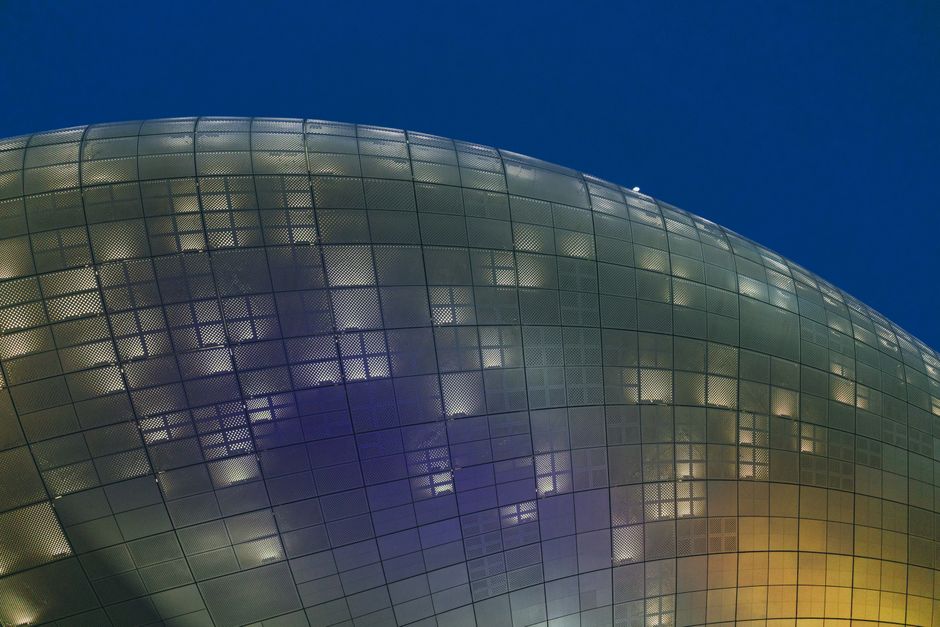
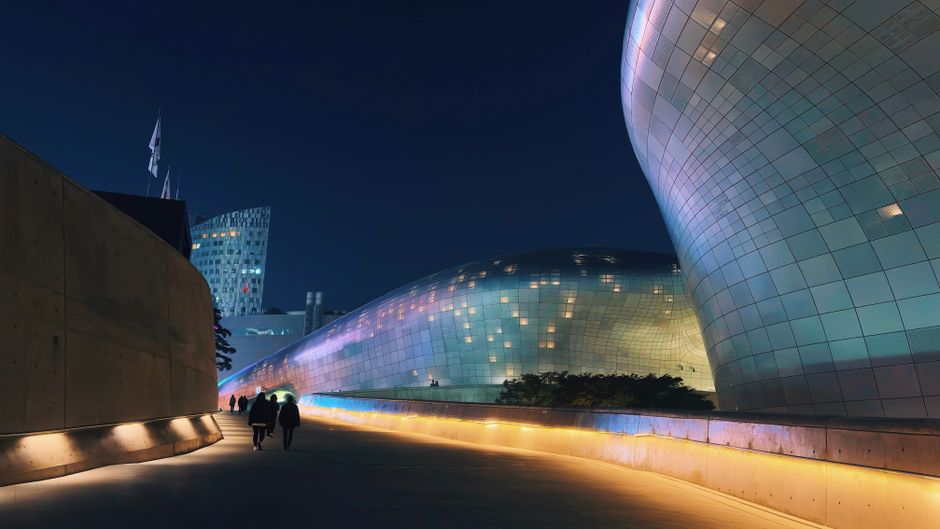
The Dongdaemun Design Plaza opened in 2014, designed by Zaha Hadid, on the footprint of the old Dongdaemun stadium — a single sweeping metallic structure of curved aluminium panels that reads, at midnight in particular, as the most legible piece of architecture in Seoul. The building operates on a longer schedule than the museums: the lower exhibition halls and design galleries close around eleven, but the public courtyards, the rose garden along the eastern edge, the LED rose installation, and the stairs along the western façade remain open and, on a clear night, are the right first hour of a Dongdaemun visit. One walks the full perimeter — about twenty-five minutes — pauses at the rose garden to read how the curves resolve against the Heunginjimun gate to the north, and continues into the towers from the northwest corner of the plaza. The architecture is not a destination in the museum sense; it is the framing through which one enters the shopping district, and the framing matters. What recommends the building, beyond the design itself, is the contrast: the Hadid curve and the mid-century commercial towers across the street are doing different things in the same neighbourhood, and the night light makes the difference visible.

Reading the towers — Doota, Migliore, Hello apM, Lotte Fitin
Inside the shopping district perimeter, four towers anchor a measured visit. Doota — formally Doota Mall — is the most editorially curated of the towers, eight floors of mid-priced Korean designer concessions with a register closer to a Hong Kong APM than to a Mongkok Ladies' Market; the staff speak partial English, the booths are larger and better-lit, and the brand selection runs the contemporary Korean spectrum. The hours run roughly from six in the evening to five in the morning, with most floors fully staffed by ten. Migliore is the louder, denser, more wholesale-priced building across the street — narrower booths, faster turnover, harder negotiation expected, and the kind of ground-floor menswear that fills out a buyer's order in a single hour. Hello apM sits in between the two: priced closer to Migliore, curated closer to Doota, and quieter on a weeknight. Lotte Fitin, on the southern edge of the perimeter, holds a department-store register — fixed prices, English signage, and a more international shopper. One does not visit all four in a single night. The right edit is two — typically Doota for the curated browse and Migliore for the wholesale-priced specifics — across two hours, with Hello apM as a third option only if one has the legs and the wallet for it.
Pricing, negotiation, and the wholesale floors
Pricing in Dongdaemun reads in three registers. The retail floors of Doota and Lotte Fitin operate at fixed prices — closer to Apgujeong department-store rates, with occasional mid-tier discounts — and negotiation is unwelcome. The retail floors of Migliore and Hello apM operate at semi-fixed prices — sticker-marked, but with five to ten percent flexibility on cash payment, and slightly more on a multi-piece purchase. The wholesale floors — typically the upper floors of Migliore and the dedicated wholesale buildings to the north of the main perimeter — operate at twenty to forty percent below the retail floors, with the trade being minimum order quantities (often three pieces per style or per colour) and a different staff register that does not always welcome single-buyer browsing. For a guest from Hong Kong used to the Mongkok markets, the calibration is closer to a Tokyo wholesale district than to a market: vendors are professional, prices are firm at the second offer rather than the fifth, and the negotiation is performed at a quieter volume. 講價要客氣, in my mother's phrasing — courteous, low-volume negotiation, with a small smile. Card payment works in Doota, Hello apM, and Lotte Fitin universally; in Migliore the upper floors are increasingly card-friendly but cash retains a small price advantage. Carrying two hundred thousand won in cash, plus a card, covers any single visit.
The food register — and a midnight meal between towers
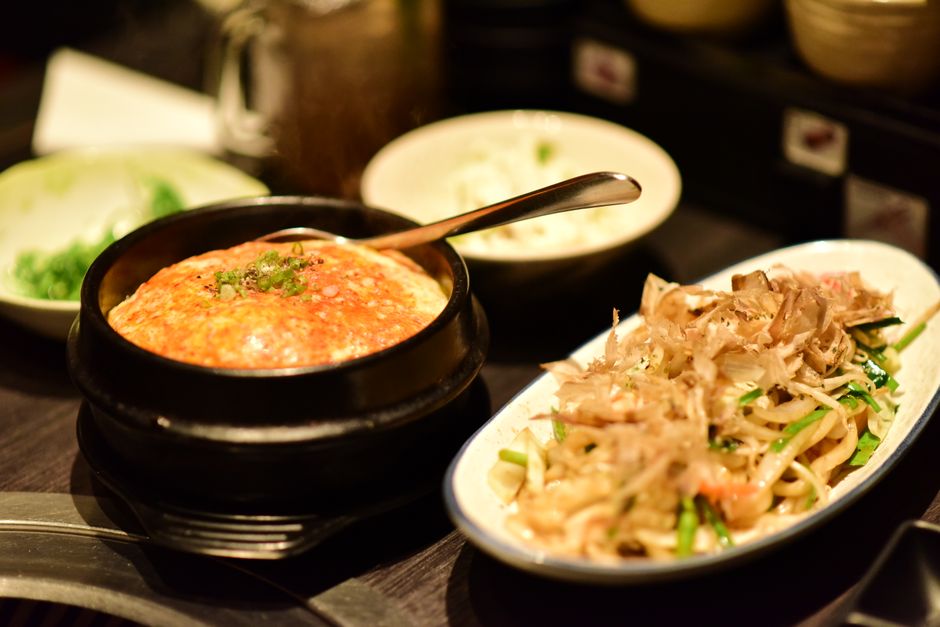
Dongdaemun's late-hour food register is not the Gangnam tasting-menu register, and one would not visit the district for a meal alone — but the midnight food belongs to the night, and a small bowl of something between the second and the third tower is the right pacing. The canonical option is kalguksu — knife-cut wheat noodle soup — at the Dongdaemun kalguksu alley, a single side lane to the south of the Heunginjimun gate where four or five small restaurants operate around the clock, all serving the same dish at roughly the same price (eight to ten thousand won per bowl). The dish is comforting rather than spectacular; the rooms are functional rather than designed; the foot traffic at one in the morning is a mix of wholesale buyers, late-shift garment workers, and the small editorial visitors who have read about the alley. A second option is the night-market food along the southern wall of the DDP — vendor stalls open until two in the morning, with the standard street register (tteokbokki, eomuk, fried mandu, soft-serve). The trade with the alley is atmosphere; the trade with the night-market is faster service. Either pairs with the towers naturally — forty minutes between the second and third stop, no reservation, eight to twelve thousand won. One does not order alcohol; the cadence of the rest of the night is wrong for it.
The return: closing the night before two, and what the next morning costs
The most useful single rule for a Dongdaemun night from Gangnam is to close the visit before two in the morning. The towers themselves run to four or five, but the return cadence — taxi availability, the body's recovery, the next morning's clinic appointment if there is one — is cleanest when one leaves the perimeter between one-thirty and two. A Kakao T booking from the DDP forecourt or the lobby of Doota arrives in three to five minutes on a weeknight; the metered fare back to a southern Gangnam hotel runs fifteen to twenty thousand won with the late-night surcharge applied; the avenue traffic at this hour clears, and the door-to-door is twenty minutes. The next morning is the variable. A late-night Dongdaemun, even an unhurried one, costs something — three or four thousand additional steps, a slightly later wake, a body that asks for an extra hour before the day starts — and one plans the next morning around it. If a clinic consultation is on the schedule, I would suggest scheduling it after eleven rather than at nine; if a treatment is on the schedule, I would not recommend the night before. For a recovery afternoon followed by a Dongdaemun night, the pairing works. For a treatment day followed by a Dongdaemun night, the pairing does not. 第二朝實累, my friends would tell me — the next morning will tire — and they would be right.
Frequently asked questions
What is the actual transit time from a Gangnam hotel to Dongdaemun late at night?
Twenty-five minutes by taxi outbound after eleven, twenty minutes back after one in the morning. The route uses the Hannam Bridge crossing, Itaewon-ro, and Jangchung-ro into the southern edge of the Dongdaemun perimeter. The metered fare runs twelve to eighteen thousand won outbound and fifteen to twenty back with the late-night surcharge.
Is the subway a viable option late at night?
No. The Seoul subway closes around midnight in either direction, which is roughly when a Dongdaemun visit becomes interesting. The night bus network reaches the area but adds twenty minutes and a transfer. A taxi or a Kakao T booking is the right tool for this specific window.
Which towers are worth visiting on a single night?
Two, not four. Doota for the curated browse and Migliore for the wholesale-priced specifics is the canonical pair. Hello apM works as a third only if one has the legs and the wallet. Lotte Fitin reads more as a department store and is a separate kind of visit. Two towers across two hours is the right cadence.
Is negotiation expected, and what is the etiquette?
On the retail floors of Doota and Lotte Fitin, no — prices are fixed. On Migliore and Hello apM, yes — five to ten percent on cash, slightly more on a multi-piece purchase. The negotiation is courteous and low-volume; the calibration is closer to a Tokyo wholesale district than to a Mongkok market. Two hundred thousand won in cash plus a card covers any single visit.
Where should one eat at midnight in the district?
The Dongdaemun kalguksu alley south of the Heunginjimun gate — four or five small restaurants serving knife-cut noodle soup at eight to ten thousand won per bowl, open around the clock. The night-market stalls along the southern wall of the DDP are the faster alternative. Forty minutes between the second and third tower is the right pacing.
Is the DDP itself worth visiting at night?
Yes — the building is the right first hour. Zaha Hadid's curved aluminium structure, the rose garden along the eastern edge, the LED rose installation, and the stairs along the western façade are open and lit until late. One walks the perimeter in about twenty-five minutes, then enters the towers from the northwest corner of the plaza.
When should one leave to return to Gangnam?
Before two in the morning. The towers run to four or five, but the return cadence — taxi availability, the body's recovery, the next morning — is cleanest when one leaves between one-thirty and two. A Kakao T booking from the DDP or Doota lobby arrives in three to five minutes on a weeknight.
Is a Dongdaemun night appropriate the day before a treatment?
No. The pairing works for a recovery afternoon followed by a late-night visit, but not for the night before a treatment. The next morning will be a slower one — three or four thousand extra steps, a later wake, a body asking for the extra hour. Schedule a treatment day morning before, or a clinic consultation after eleven.