A Reader's Seoul
COEX & Starfield Library: A Reading Detour in Asia's Largest Underground Mall
A Hong Kong reader's route through COEX's underground city — the Starfield Library, its quiet corners, and a sensible rainy-day pacing.
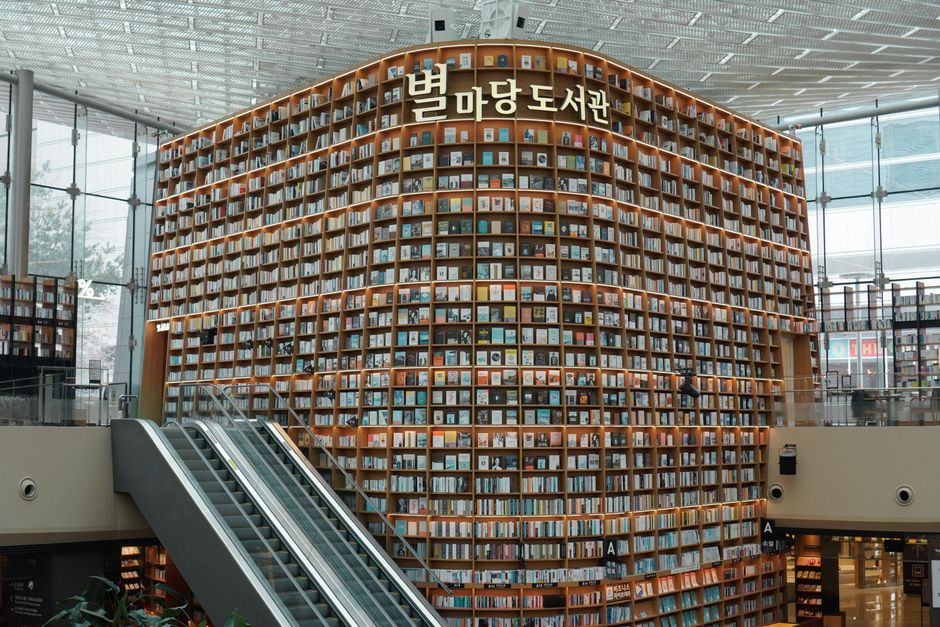
One descends at Samseong station, takes the unmarked left, and walks for what feels like half a kilometre before the mall opens out — and then the Starfield Library appears, all thirteen metres of vertical shelving, lit like an opera-house lobby that has decided to read. COEX is, by most reasonable measures, the largest underground shopping complex in Asia; it is also a working city that swallows whole afternoons, particularly in the rain. Hong Kong readers know this kind of room from Pacific Place or the IFC mall — connected, climate-stable, indifferent to weather — but COEX is wider, slower, and more democratic. The library at its heart reads, on first impression, like a stage set. Stay an hour and one finds the actual readers — students, retirees, a parent with a sleeping child. 慢慢嚟, as one might say. The route below is what I send Hong Kong friends arriving with a free Sunday and a pressing forecast of cloud.
Why COEX is the rainy-day answer
COEX is a 154,000-square-metre underground complex — the largest of its kind in Asia by most published counts — that connects Samseong station, the Trade Tower, the InterContinental hotels, and the Hyundai Department Store into one weather-sealed walking grid. What this means in practice, for a Hong Kong reader: one can arrive at Samseong on Seoul Metro Line 2, walk for three hours, and never need an umbrella. The complex holds an aquarium, a multiplex cinema, the convention centre itself, a thousand-bay car park, and the Starfield Library at its symbolic centre. The room reads as Hong Kong's Times Square — a podium mall under tower — except horizontal rather than vertical, and considerably larger in floorplate. A March Saturday in Seoul will quite reasonably deliver eight degrees and steady rain; a humid Hong Kong July reads the same. On both, COEX is the considered answer. It is also, by design, intuitive: the signage is bilingual Korean-English, the maps are at every major junction, and a misstep simply opens onto another corridor. One does not get lost so much as redirected, gently.
Getting in — the transit picture
Three transit lines deliver one to COEX, and the choice matters for the route within. Samseong station on Line 2 — the green line — is the canonical entrance, with direct underground access via Exits 5 and 6 that put one inside the mall without surfacing. Bongeunsa station on Line 9 — the gold line — delivers one to the northern edge near Bongeunsa Temple, a useful pairing for a slower morning. Cheongdam station, also on Line 7, sits a fifteen-minute walk to the north-east and reads as the right answer if one's hotel is in Cheongdam itself. From Incheon Airport, the AREX express to Seoul Station takes 43 minutes, with a Line 2 transfer of roughly twenty more — a full hour, including the walking. A taxi from a Sinsa or Apgujeong hotel runs KRW 6,000-9,000 on a normal afternoon, slightly more in rain or peak hours. The InterContinental Seoul COEX, for guests, has a direct internal corridor — one walks from lobby to mall without a coat. For our slower read of the after-hours café scene one descends to from this same station, see the late-night café guide. For the daytime coffee scene that pairs with a library afternoon, the coffee culture guide reads the broader Gangnam picture.

The Starfield Library — when to arrive, where to sit
The Starfield Library is an open public reading room of approximately 2,800 square metres, opened in May 2017, designed by Cho Min-suk of Mass Studies. The structural fact that defines the room is the height of the shelving: thirteen metres at the tallest stacks, with a collection that runs to roughly 50,000 books and 600 periodicals. Most are in Korean; a useful subset are in English and Japanese; a smaller but growing shelf holds Chinese-language titles. Reading is free; no membership is required; one may stay as long as one likes. The room is, predictably, photogenic — the Instagram queue is real and runs heaviest between two and four in the afternoon on weekends. For a Hong Kong reader after the room itself rather than the photograph, the considered windows are weekday mornings between ten and twelve, or weekday evenings after seven. The lighting at seven is particular — warm, low, slightly theatrical — and reads, in person, like the Mandarin Oriental lobby on a Tuesday. Seating runs along the two long flanks; the central spine is reserved for circulation. The quietest tables are along the east wall, partially screened by stacks. Power outlets are scarce; bring a charged device. Wi-Fi is free, no Korean phone number required.
A two-hour reading loop
A reasonable Sunday loop, calibrated for a single reader on a single afternoon, begins at Samseong Exit 5 at half past one and ends at Bongeunsa Exit 6 at five. The pacing rewards a slow walker. From Samseong, one moves north through the central concourse — past the Mega Box cinema entrance, past the food court that thickens around two — and arrives at the Starfield Library by the south entrance at one-forty. The light at this hour is bright but not harsh; the room reads well. One stays an hour, with a book pulled at random from the English shelves on the second-level mezzanine. At two-forty one moves east through the connecting concourse to the Hyundai Department Store basement, where the food hall — Tous Les Jours, Paul Bassett, a respectable bakery rotation — offers a sit-down coffee for thirty minutes. At three-fifteen one returns to the library for a second hour. The room has filled; the Instagram queue has formed; the lighting has begun to shift. By four-thirty one exits north toward Bongeunsa station, with a quick optional detour through the COEX Aquarium courtyard for the late-afternoon stillness. Five o'clock at Bongeunsa Exit 6 — and a five-minute walk to the Bongeunsa Temple half-day if the mood permits, or a taxi home if it does not.

The food picture — where one eats inside COEX
COEX's restaurant inventory is comprehensive and uneven; the better tables are the considered ones, not the food-court ones. The Hyundai Department Store basement runs a multi-vendor hall that includes a respectable Tous Les Jours, a Paul Bassett coffee counter, and several Korean street-food specialists — tteokbokki, gimbap, bibimbap — at twelve to twenty-thousand won for a substantial plate. The InterContinental's Brasserie, accessible by an internal corridor, holds a more refined afternoon tea between two and five for around KRW 65,000 per person, with a window onto the Trade Tower; the Park Hyatt lobby (a fifteen-minute walk north) offers a quieter alternative. For a substantial Korean lunch one walks south to the Megabox-side corridor, where a handful of hansik counters serve set meals in the KRW 18,000-28,000 range. The food court proper — at the central concourse — is functional rather than memorable, and reads as the right answer at one in the afternoon when the library queue is heaviest. A Hong Kong reader who has eaten at the IFC food hall will recognise the structure immediately. Vegetarian and halal options exist but require searching; the better answer is the Brasserie, which adapts on request. For a fuller read of the Gangnam tasting-menu scene by evening, our tasting-menu map is the considered next read.
Practical notes — payment, restrooms, hours
A Hong Kong reader will find COEX's practical layer broadly intuitive and well-signposted. The complex opens at ten in the morning and closes at ten in the evening; the Starfield Library itself runs from ten-thirty until ten. The Aquarium runs ten until ten with last entry at nine. Restrooms are plentiful, clean, and free — one finds them at every major junction, signed in English. Payment is contactless almost universally; foreign Visa, Mastercard, Apple Pay and Samsung Pay all read at the counter. Korean QR systems are unnecessary. Tipping is not expected. Smoking is forbidden indoors complex-wide; designated outdoor zones sit at the perimeter. The mall holds two information desks — one near Samseong Exit 5, one near the Hyundai entrance — both staffed by English-speakers who hand out paper maps. Lockers run KRW 2,000-4,000 for a half-day, useful if one is arriving with luggage from the AREX. The complex is wheelchair-accessible throughout; pram-friendly; equipped with quiet-rest nooks near the library's south end. For our handbook on the cab apps that close the day, see the taxi app handbook.
An editor's rainy-Sunday plan
If a Hong Kong reader asked me for a single rainy-Sunday plan in Gangnam, this is what I would send. Wake unhurried; take coffee at the hotel; arrive at Samseong Exit 5 at one. Walk the south-to-north spine slowly. The Starfield Library at one-forty for a first hour with a book pulled at random — the English shelves are the right answer for a first visit. A coffee at the Hyundai basement at two-forty. A second hour at the library at three-fifteen, when the light begins its shift. The COEX Aquarium courtyard at four-thirty for the late-afternoon hush. Bongeunsa Exit 6 at five — and either the temple, if one has the energy, or a taxi to the hotel and an early dinner. The Korea Tourism Organization's COEX primer is a useful pre-read for first-time visitors; their entry on the Samseong-dong cultural cluster reads the broader district well.
Frequently asked questions
Is the Starfield Library free to enter?
Yes — the library is a free public reading room, open without membership or ticket. One may stay as long as one likes, read from the open stacks, and use the seating without charge. The room runs from ten-thirty in the morning until ten at night. There is no dress code; bags are not searched; coffee from outside is broadly tolerated provided it is lidded and one is careful around the stacks.
When is the Starfield Library least crowded?
Weekday mornings between ten-thirty and twelve are reliably quiet, with a noticeable thickening from one o'clock as the lunch crowd moves through. Weekday evenings after seven are also calm and offer the most flattering lighting. Weekend afternoons between two and four hold the Instagram queue and read busy throughout. For a reading visit rather than a photograph, weekday off-peak hours are the considered window.
How long does it take to walk from Samseong station to the library?
From Samseong Exit 5 it is roughly seven to ten minutes underground, depending on pace and crowd density, with no need to surface. The route is well-signed in Korean and English; one follows the central concourse north past the Mega Box entrance. From Bongeunsa station Exit 6 it is approximately five minutes, also underground. From Cheongdam station it is a fifteen-minute walk, partly above ground.
Are there English-language books at the Starfield Library?
Yes — a meaningful subset of the roughly fifty-thousand-book collection is in English, with smaller shelves in Japanese and Chinese. The English titles cluster on the second-level mezzanine and lean contemporary fiction, design, photography, and architecture. The collection is not exhaustive — one will not find a research library — but it is varied enough for a comfortable two-hour read. Periodicals include several English-language magazines and newspapers.
Can I pay with a foreign credit card inside COEX?
Yes — contactless Visa, Mastercard, Apple Pay and Samsung Pay are accepted at virtually every counter inside COEX, including the food court, the Hyundai Department Store, and the cinema. Korean QR payment systems — Kakao Pay, Naver Pay — are not necessary for foreign visitors. Cash is rarely needed. Some smaller specialty boutiques may require a magnetic-strip swipe rather than contactless, which a foreign card handles without difficulty.
Is COEX a good rainy-day plan for families?
Yes — the complex is fully indoor, climate-controlled, and family-equipped throughout. The Aquarium runs ten until ten with last entry at nine; the multiplex cinema holds international titles with English subtitles; the food hall caters to a wide age range. Restrooms include nursing rooms and family stalls. Strollers are accommodated by wide concourses and lifts. The Starfield Library itself is suitable for older children; younger ones may grow restless after fifteen minutes.
Is the COEX Aquarium worth a separate ticket?
It depends on the company. The Aquarium is a respectable mid-size institution rather than a flagship — pleasant rather than essential — and rewards visitors with children, or visitors with a full afternoon to fill. Adult admission runs roughly KRW 28,000-32,000; child tickets are reduced. Allocate ninety minutes for a comfortable walk-through. Hong Kong visitors who know Ocean Park will read it as a small urban analogue, well-curated, undemanding.
How do I get back to my hotel from COEX at night?
The Seoul Metro runs until midnight on most lines, with last trains from Samseong and Bongeunsa stations slightly earlier. After midnight, a Kakao T or UT taxi to a Sinsa, Apgujeong, or Yeoksam hotel runs KRW 6,000-9,000 and arrives within four minutes; both apps run in English and accept foreign cards. The InterContinental Seoul COEX, for guests, requires no transit at all — the internal corridor closes only between two and five for cleaning.