A Reader's Seoul
Cheongdam Decoded: Inside Seoul's Quietly Luxurious Quarter
A Hong Kong editor's reading of Cheongdam — maison cafés, flagships, and the Mid-Levels parallel.
Cheongdam-dong does not announce itself. One arrives off the Bundang Line, walks two blocks east, and the city quietly recalibrates — the storefronts lengthen, the windows hold one object instead of twelve, and the cars idling at the kerb sit a half-tier above what one sees five stops west. It is, in temperament, the closest Seoul comes to Hong Kong's Mid-Levels — vertical money read horizontally, a residential quarter that doubles as a maison district. The pedestrian rhythm is slow, the lighting is low, and the cafés serve their lattes in porcelain that would not look out of place at the Mandarin Oriental. 呢度好低調, a Causeway Bay friend texted me on her first walk through. She wasn't wrong.
Reading Cheongdam against Mid-Levels
Cheongdam-dong is the eastern half of Seoul's Gangnam district — a residential-commercial quarter bounded roughly by the Han River to the north, Apgujeong to the west, and Samseong-dong to the south, holding the densest concentration of European luxury flagships in the country. The parallel to Hong Kong's Mid-Levels is structural rather than aesthetic. Both are vertically wealthy quarters that present themselves modestly at street level — the buildings low-storey on the avenue, the real holdings stacked above. In Mid-Levels one walks Caine Road and reads the postcodes on the mailboxes; in Cheongdam one walks the main avenue between Galleria and the Hyundai dealership and reads the flagships. Louis Vuitton's maison sits on the corner — a glass-paneled building that doubles as a private salon for clients above a certain spend tier. Dior, Saint Laurent, and Hermès each hold their own avenue presence; the Hermès maison is, by quiet consensus, the most considered piece of luxury retail architecture in the country. The avenue itself is wider than one expects — the same six-lane breadth one finds along Apgujeong Rodeo — which gives the storefronts room to read. It is, in short, the kind of district where one does not bring a camera. The locals do not photograph their neighbourhood. Nor, after a day or two, does the considered visitor.

The maison cafés — porcelain, marble, and the quiet hour
The Cheongdam café register sits a measurable step above what one finds elsewhere in Gangnam — the bean tier higher, the pour technique slower, the porcelain heavier. Several of the flagship maisons run their own cafés on the upper floors of their boutiques; the Dior café on the avenue is the most-discussed of these, but the Maison Hermès café, on the rooftop of a quietly handsome building, is the more rewarding sit. A long black at this tier runs between KRW 12,000 and KRW 22,000 (broadly USD 8.50 to USD 15.50), which reads steep against the chains but in line with what a Conrad lobby or a Mandarin Oriental tea room quotes for the same drink. The independent specialty cafés — there are perhaps a dozen worth marking, scattered through the alleys behind the avenue — sit between KRW 7,000 and KRW 12,000 and offer single-origin filter, slow drip, and the occasional tea pairing. Service is unhurried; the rooms are quiet; one does not need a reservation, though for the rooftop floors a brief weekend wait is unsurprising. The dress code is unwritten but legible — pressed linen in summer, considered knitwear in winter. One does not arrive in athleisure. For a contrasting register, see our late-night café guide for the chain culture that holds the small hours.
Flagship architecture as urban grammar
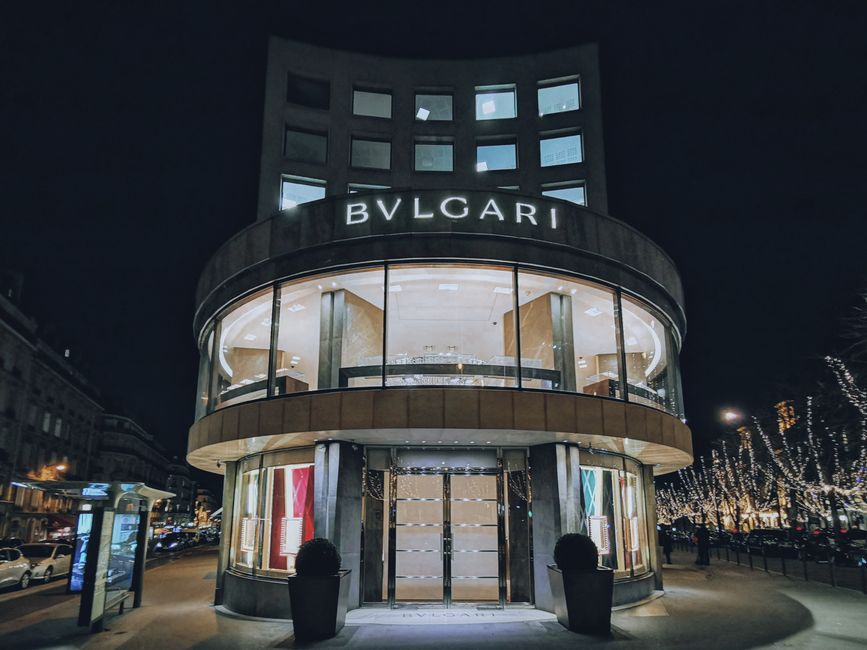
The flagships of Cheongdam are not just shops; they are a reading of how the district understands itself. Louis Vuitton's building, designed by Frank Gehry with Peter Marino, opened on the avenue several years ago — a glass-and-steel structure that, by day, reads as a sculpture and, by night, lights from within as a lantern. The Dior boutique, ribboned in white pleated glass, was designed by Christian de Portzamparc with Peter Marino interiors and is, by some readings, the most refined maison architecture outside Paris. Hermès, more modest in scale, holds the corner with an orange-and-cream facade that reads as a discreet acknowledgement of its Faubourg origins. Gentle Monster — Seoul's own architectural retail brand — anchors a flagship a block south of the main avenue and is, perhaps surprisingly, worth the detour for the interiors alone (the brand's installations rotate quarterly and are free to walk). The cumulative effect, for a Hong Kong reader, is a quarter that has solved a problem Central is still negotiating — how to present luxury at the scale of architecture rather than at the scale of the shop window. One walks the avenue not to buy but to read. For Apgujeong's parallel rhythm a few blocks west, our Apgujeong walking itinerary reads that quarter in detail.

Galleries, design houses, and the side-street economy
Behind the main avenue Cheongdam holds a quieter second tier — galleries, antique houses, jewellery ateliers, and the kind of design boutiques one finds tucked into the side streets of Belgravia or behind Aoyama. The Horim Museum, on the southern edge of the district, is the most established of the private collections; its rotating Korean ceramics exhibitions read as a primer for visitors new to the regional canon, and admission sits at KRW 8,000 (USD 5.70). Several private galleries — Park Ryu Sook, P21, and a number of smaller spaces — hold openings on Thursday evenings, which is the night to walk the side streets if one wants to see the local design community at home. Furniture and lighting boutiques cluster around the Dosan-daero side of the district; the Hermès-adjacent design shops are particularly worth a slow look. Antique dealers — Korean ceramics, Japanese woodblock, the occasional European piece — hold a few shopfronts on the avenue's western run. The side-street economy is markedly slower than the main avenue's flagship rhythm; one wanders into a four-table jewellery atelier, takes tea, and emerges without obligation. This is, again, the Mid-Levels parallel — a residential quarter where the side streets hold the more interesting half of the district.

Where to stay, and the recovery-friendly calculus
Cheongdam itself holds a modest hotel inventory — the Andaz Seoul on Apgujeong-ro is the closest international flagship, sitting on the western edge of the district and within a fifteen-minute walk of the main avenue. The Park Hyatt Seoul, slightly south in Samseong, is a more considered choice for the visitor who wants a quieter base; its rooms hold the Han River view, and the lobby coffee shop is, in itself, a Cheongdam-adjacent destination. The Josun Palace, also in Samseong, offers a brand-new luxury room product and a service register that reads — to a Mandarin Oriental regular — as familiar. For wellness travellers in particular, the room calculus matters: blackout curtains, generous bathtub, low-floor option for those avoiding lift waits, and a quiet corridor are the four asks that matter. All three hotels above hold these as standard at the suite tier. The neighbourhood's quietness is its own asset for recovery; the cars do not honk, the avenue does not light up before nine, and the breakfast service at any of these hotels can be taken at a slow pace. Our where-to-stay wellness guide reads the hotel cluster in district-by-district detail.
Practical notes — transit, payment, etiquette
Cheongdam is served by Cheongdam Station on the Bundang Line, with Apgujeong Rodeo Station on the Suin-Bundang Line a short walk west; both lines connect to the wider Seoul metro within one or two transfers. The Express Bus Terminal is a fifteen-minute taxi ride south-west, and Incheon Airport sits within an hour by AREX with a transfer at Seoul Station or a forty-five-minute door-to-door by KAL Limousine. Payment in Cheongdam runs the gamut — flagships accept contactless Visa, Mastercard, and Apple Pay without hesitation, and a Korean Knockoff card is unnecessary. Cash, in this district, reads slightly odd; one does not pay in won bills at a Hermès counter. Tipping is not expected and would be politely declined. The dress register matters more here than elsewhere in Seoul — the flagships are walk-in, but the staff read appearance, and a considered outfit moves the experience along. Voice volume is also a tell; the district is quiet, and one speaks quietly. For the cab handbook itself, see our taxi app handbook on Kakao T and UT.
An editor's half-day in Cheongdam
If a Hong Kong reader asked for a half-day Cheongdam plan, this is what I would send. Arrive at eleven, off the Bundang Line at Cheongdam Station, and walk the main avenue north toward the Han River — past Louis Vuitton, Dior, and Hermès on the eastern side. At noon, the rooftop café at Maison Hermès for a long black and a quiet sit. At one, the Horim Museum for a slow read of the current ceramics show. At two-thirty, the side streets behind Dosan-daero for the jewellery ateliers and design boutiques. At four, tea at one of the independent specialty cafés on the avenue's western run. By five, a walk to the Apgujeong-Rodeo footbridge for the Han River read. This is the unrushed version; one can compress it to three hours if needed, but Cheongdam does not reward compression. The Korea Tourism Organization keeps a useful primer on Gangnam-gu for first-time visitors, and the Seoul Metropolitan Government's Gangnam district pages hold the more detailed maps.
“Cheongdam reads, on first impression, as Seoul's quietest answer to a question Mid-Levels has been asking for twenty years — how does a residential quarter hold luxury without announcing it?”
Liu Mei-Hua, editorial notebook
Frequently asked questions
Is Cheongdam-dong walkable from Apgujeong, or do I need transit?
The two quarters sit within a fifteen-minute walk of one another along Apgujeong-ro. From Apgujeong Rodeo Station east to Cheongdam Station the avenue is wide, pavemented, and pleasant in mild weather. In summer monsoon or winter cold, the Bundang Line single-stop is the considered choice. For tourists tracking time, the walking option doubles as the district read.
Can I walk into a Cheongdam flagship without an appointment?
Yes — the maisons on the main avenue are walk-in for ground-floor browsing, and the staff will offer tea or coffee on arrival. Upper-floor private salons require an appointment, usually through the client's personal advisor. The dress register reads pressed and considered; athleisure is technically permitted but reads against the room. A Mandarin Oriental afternoon-tea wardrobe is the comfortable register.
What do the maison cafés cost compared to Cheongdam's independent specialty cafés?
Maison cafés sit between KRW 12,000 and KRW 22,000 (USD 8.50 to USD 15.50) for a long black or specialty drink, broadly aligned with hotel lounge pricing. Independent specialty cafés in the side streets run between KRW 7,000 and KRW 12,000 (USD 5.00 to USD 8.50). Chain cafés — Mega, Compose, Hollys — sit at KRW 3,000 to KRW 5,500 (USD 2.20 to USD 4.00) for the same drinks.
How does Cheongdam compare to Hong Kong's Mid-Levels?
Cheongdam and Mid-Levels share a structural temperament — vertically wealthy residential quarters that present modestly at street level — but the retail density differs. Cheongdam holds Korea's densest concentration of European maison flagships in a six-block avenue; Mid-Levels is residentially heavier with retail concentrated in Central below. The lighting and pavement rhythm read similar; the quiet hour falls at eight in the evening in both.
Is Cheongdam a good base for a wellness or recovery-focused trip?
Yes — the district's quietness is its primary asset for recovery travellers. Cars do not honk after eight, the avenue does not light up until nine, and the hotel inventory (Andaz Seoul, Park Hyatt Seoul, Josun Palace within fifteen minutes) holds suites with blackout curtains, deep bathtubs, and quiet corridors. The medical-grade aesthetic clinic cluster sits within a five-minute taxi ride to the west.
Are there galleries and museums worth visiting in Cheongdam?
The Horim Museum (Korean ceramics, KRW 8,000 admission, USD 5.70) is the most established private collection in the district. Park Ryu Sook Gallery and P21 hold rotating contemporary shows; the surrounding side streets concentrate roughly a dozen smaller private spaces. Thursday evening openings — between six and eight — are the considered visit for the local art community at home.
What is the best time of year to walk Cheongdam?
Late April through mid-June, and mid-September through late October, are the considered windows. Cherry blossoms along Apgujeong-ro run for ten days in early April; the autumn foliage at Dosan Park, on the western edge of the district, peaks in the third week of October. Summer monsoon (late June through July) and the January cold are best read indoors — the flagships and museums hold the day. See our autumn foliage walks for the seasonal read.