A Reader's Seoul
Half a Day at Bongeunsa: Templestay Light, Across from COEX
A Hong Kong reading of Gangnam's working Seon monastery — half-day temple program, urban meditation, and a mini-retreat across the boulevard from Asia's largest mall.
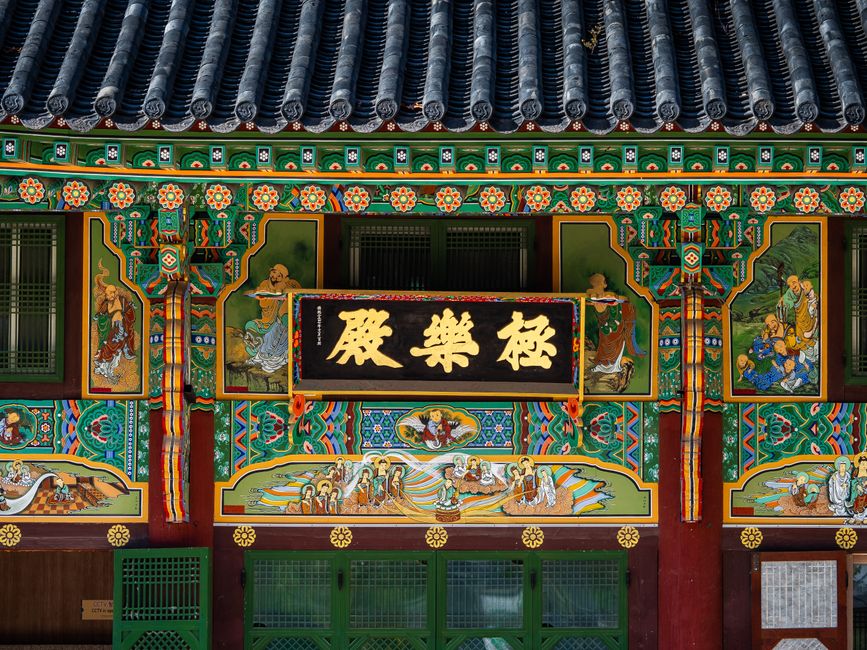
There are few sights in Seoul as unaccountable as Bongeunsa's main hall framed by the COEX towers — a thousand-year temple roof rising into a glass-and-steel skyline that one usually associates with Pudong or Admiralty. One crosses Bongeunsa-ro at a six-lane pedestrian light, climbs eight stone steps, and is — by some quiet alchemy of Korean urban planning — inside a working Seon Buddhist monastery. The bell hall rings at sunrise; the monks chant; the lay practitioners arrive in stockinged feet for the morning service. 呢度真係另一個世界, as a Cantonese friend put it after her first visit. The temple offers a half-day program designed for travellers — three hours, no overnight, an authentic introduction to a meditation tradition that predates Seoul itself. This is the reading.
What Bongeunsa is
Bongeunsa is a working Seon Buddhist monastery founded in 794 CE during the Silla dynasty, currently administered by the Jogye Order — the largest Buddhist organisation in Korea — and seated on a wooded hillside across Bongeunsa-ro from the COEX Convention complex in Samseong, Gangnam. The temple covers roughly 64,000 square metres of slope, hall, and pine forest — small for a major Korean monastery, vast for what one expects to find a block from a luxury department store. Eight principal halls structure the visit: the Daeungjeon main hall, the Panjeon scripture archive, the Yeonggak ancestral hall, the Mireuk Daebul standing Buddha at twenty-three metres, and four secondary halls for the bodhisattvas. The Panjeon contains 3,479 woodblocks of Buddhist sutras carved between 1855 and 1899 — the largest collection of late-Joseon temple woodblocks in the country, designated National Heritage. Daily monastic life continues — early-morning chanting at four, dawn service at five-thirty, the daily offering at ten-thirty — and the temple welcomes lay visitors throughout, with structured programs for international travellers. Admission is free; one is asked to remove shoes inside the halls and to speak softly throughout.
Templestay Light — the half-day program
The Templestay Light program is Bongeunsa's three-hour introduction for travellers who cannot — or are not yet ready to — commit to the overnight stay. The session runs on weekend mornings, beginning at ten and concluding by one, and follows a structured arc: a temple-orientation walk, a session of Seon sitting meditation under a guiding monk, an introduction to the 108-prostration practice in abbreviated form, a vegetarian temple lunch served in the barugongyang style, and a closing tea conversation. The cost runs KRW 50,000 per person — roughly USD 36 — and includes the lunch, a temple-robe loan for the duration, and a small bound notebook. English-language sessions are offered every Saturday year-round; one books through the Templestay Korea official portal at least three days in advance. The cohort is small — eight to twelve participants — and the guiding monk speaks fluent English. What recommends the program over a self-directed visit is the barugongyang meal: one eats four bowls in strict silence, finishes every grain, and rinses the bowls with hot water that one then drinks. The discipline reads as unfamiliar at first and then, by the second course, as a quiet pleasure. For a slower exploration of Gangnam's surrounding temple-and-park network, see our Seonjeongneung morning piece — the two sites pair on a single half-day.

Walking the grounds — a self-directed route
A self-directed visit fits comfortably into ninety minutes, and the considered route enters from the Iljumun main gate — the southern entrance off Bongeunsa-ro, directly opposite COEX exit six. The path climbs gently through a short stretch of pine to the Beopwangru — the lecture hall whose lower storey houses the temple shop — and then opens onto the main courtyard. The Daeungjeon main hall sits at the courtyard's far end, behind a stone lantern and a 200-year-old Korean maple. One removes shoes at the wooden threshold and enters; the principal Buddha figure is flanked by two bodhisattva attendants and faces a silk-painted ceiling that rewards a slow upward look. From the main hall the path swings left to the Panjeon scripture archive — wooden, weathered, with the 3,479 woodblocks shelved behind glass — and then climbs further to the Mireuk Daebul, the twenty-three-metre standing Buddha of the future. The view from the standing-Buddha terrace takes in the COEX skyline at one's feet — the temple's most photographed angle and, despite the obvious cliché, still a moving juxtaposition. The descent loops west through pine and oak past the Yeonggak ancestral hall — quieter, less photographed — and exits at the Iljumun gate.

What to expect at the meditation session
A first-time Seon meditation session at Bongeunsa runs forty-five minutes inside the dedicated meditation hall — a wooden, sock-feet-only room with cushioned mats facing a low altar. The guiding monk demonstrates the half-lotus seat, the hand mudra, and the breath-counting method — susikgwan, the elementary Seon technique — and then the room sits in silence for thirty minutes. A small wooden clapper marks the opening and closing; the monk walks a slow patrol with a long wooden stick used, traditionally, to tap a drowsy practitioner on the shoulder. The stick reads at first as theatrical and then, by the second sit, as a quiet kindness. For a Hong Kong visitor familiar with the meditation rooms at Po Lin or Chi Lin, the technical vocabulary will read closely; the chief difference is the Korean preference for the half-lotus rather than the Burmese seat, and a slightly more upright spine. No prior practice is required. Cushions and small folding stools are provided for those who cannot sit on the floor. A quiet thirty minutes inside this room, with the COEX traffic muted to a distant rumble beyond the courtyard wall, is — in my reading — the best meditation introduction available to a casual traveller in central Seoul.
Vegetarian temple lunch — a brief primer
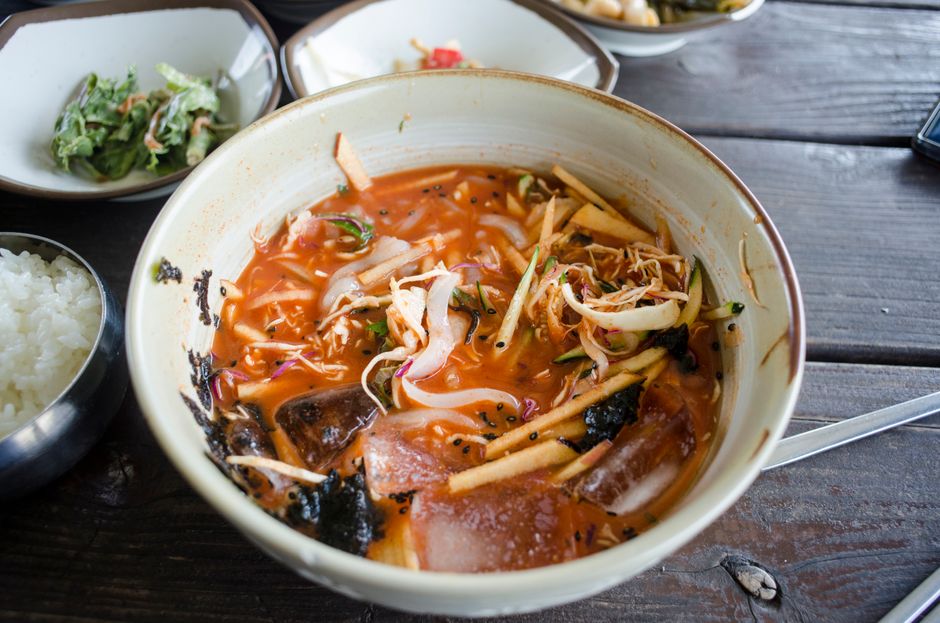
The barugongyang lunch served at the Templestay Light program is a Korean monastic discipline that traces to the Goryeo era — four nested wooden bowls, eaten in silence, in a sequence that prizes equanimity over flavour. The bowls are arranged in a precise order — rice in the largest, soup in the second, the main dish in the third, side vegetables and water in the fourth — and one is expected to finish every grain. A small piece of pickled radish is set aside at the start of the meal; one uses it at the end to wipe each bowl clean of residue, then pours hot water into the largest bowl and drinks it. The water carries any remaining trace of food and closes the meal with a small, deliberate gesture against waste. The food itself is what Korean Buddhist cuisine — sachal-eumsik — has refined over twelve centuries: no garlic, no leek, no onion, no animal product, no monosodium glutamate. The flavour vocabulary is gentle, vegetable-forward, fermented where appropriate, sweet where rare. A traveller used to the strong palette of jjigae and bossam will find the meal mild at first and, by the third bowl, surprisingly satisfying. The lunch reads as the program's quietly transformative element.
Getting there from a Gangnam hotel
Bongeunsa sits one minute on foot from Bongeunsa Station — Line 9, exit one — and three minutes from Samseong Station on Line 2 via the COEX underground passage. From a Sinsa or Apgujeong hotel the metro journey is twelve to fifteen minutes; from a Cheongdam base, a flat seven-minute taxi. A Kakao T cab from the central Sinsa hotel cluster runs KRW 5,500-7,500 — under USD 5.50 — and arrives within four minutes off-peak. For a paired morning with Seonjeongneung, Bongeunsa is two minutes' walk north of Seolleung Station on Line 2 — one stop from the royal tomb compound. The temple is open from four in the morning to ten in the evening, but the practical visiting window is between seven and six. The Templestay Light program requires advance booking through the official Templestay Korea portal — three days minimum, longer in autumn peak. For a wider read of how the temple sits within the COEX and Samseong precinct, our Coex Starfield Library piece covers the adjacent underground complex; the two sites are designed, somewhat improbably, to be walked in sequence.
Etiquette, pacing, and a quiet recommendation
Bongeunsa's etiquette is the standard set of Korean Buddhist conventions, gentler than at a Japanese Zen temple but more attentive than at a tourist-only site. Shoes are removed at every hall threshold — wooden steps mark the line — and stored on the racks provided. Voices remain low throughout. Photography is permitted in the courtyards and from the standing-Buddha terrace; it is not permitted inside any of the halls without explicit consent from a resident monk. Hats are removed at the threshold of the Daeungjeon. Drone photography is forbidden. The dress code is broad — long shorts and short sleeves are accepted — but a covered shoulder is the considered choice for an extended visit. For a wellness traveller pacing a recovery itinerary, the temple reads as the soft outdoor afternoon one wants on day two or three — flat enough, contemplative, with the standing-Buddha terrace as a single rewarding climb. The Korea Tourism Organization maintains a clear English page on Bongeunsa's hours and program calendar; their entry is the only authoritative source on seasonal closures. A half-day here — three hours, one templestay program, one bowl of temple food — is, on the whole, the single most concentrated cultural reading available within the Gangnam administrative district.
Frequently asked questions
Is Bongeunsa free to enter?
Yes — admission to the temple grounds is free of charge, year-round, with no required donation. The Templestay Light half-day program is the only paid option, running KRW 50,000 per person — roughly USD 36 — and including lunch, robe loan, and a guided meditation session. Self-directed visits incur no cost; a small donation at the main hall is customary but not expected of foreign visitors.
Do I need to book the Templestay Light program in advance?
Yes — the half-day program runs in cohorts of eight to twelve participants and books through the official Templestay Korea portal at templestay.com. Three days' advance booking is the minimum; one week is recommended in autumn peak — late October through mid-November — when foliage demand spikes. English-language sessions run every Saturday year-round; weekday sessions are added during high season.
Can I attend Bongeunsa if I am not Buddhist?
Yes — the temple actively welcomes visitors of any faith or none. The Templestay programs are designed as cultural-introduction experiences rather than religious instruction, and the resident monks are accustomed to mixed-belief cohorts. One is asked to observe basic hall etiquette — shoes off, voices low, hats removed — but no devotional act is expected. The meditation session is presented as a contemplative technique rather than a religious rite.
What are the opening hours?
The temple grounds open at four in the morning and close at ten in the evening, year-round. The Daeungjeon main hall and other interior spaces are accessible between five-thirty and nine in the evening. The practical visiting window for a foreign traveller is seven in the morning to six in the evening — the early hour catches the dawn service, and the late afternoon catches the evening bell. The temple shop runs from nine to six.
Is the Templestay Light meal suitable for vegans?
Yes — Korean Buddhist temple cuisine is strictly vegan by twelve-century monastic tradition, and the Bongeunsa Templestay Light lunch contains no animal product, no garlic, no onion, no leek, and no monosodium glutamate. The food is fully plant-based, sodium-moderate, and gluten-tolerant — wheat-free options are available with twenty-four hours' notice through the booking portal. Allergies and dietary restrictions are accommodated when communicated in advance.
How does Bongeunsa get to from a Gangnam hotel?
Bongeunsa Station — Line 9, exit one — opens directly onto the temple's southern approach, a one-minute walk to the Iljumun main gate. From a Sinsa hotel the metro journey is twelve minutes with one transfer; a Kakao T or UT taxi runs KRW 5,500-7,500 and arrives within four minutes off-peak. From a Cheongdam base the taxi is seven minutes. The COEX underground passage offers a step-free indoor route from Samseong Station for rainy-day visits.
Is photography allowed inside the temple halls?
Photography is permitted throughout the courtyards, on the standing-Buddha terrace, and from the perimeter pine paths. Inside the halls — the Daeungjeon, the Panjeon scripture archive, the meditation hall — photography is not permitted without explicit consent from a resident monk. Drone photography is forbidden anywhere on the grounds by national heritage law. The standing-Buddha terrace, with the COEX skyline at one's feet, is the most photographed angle and remains permissible without restriction.