A Reader's Seoul
An Editor's Walking Itinerary Through Apgujeong Rodeo
From Dosan Park to the Rodeo block — a slow afternoon read of the quarter, with flagships, galleries, and lounges.
One arrives at Apgujeong with a Causeway Bay reflex — a sense that the whole quarter must be walked at half-speed if one is to read it properly. The avenue between Dosan Park and the Rodeo block holds a particular density of flagships, small galleries, lounges, and the quieter rooms one only finds by turning into a side street and looking up. Hong Kong's Mid-Levels has a similar reading — vertical, layered, residential at the edges and commercial at the centre — and Apgujeong rewards the same pace. The itinerary that follows is a slow afternoon — one departure, four hours, one return — and is the route I send Hong Kong friends arriving with a single free day in Gangnam.
Departure — Dosan Park, the quiet beginning
Dosan Park is a small, quiet, residential-edged green at the southwestern end of the Apgujeong quarter — the considered departure point for a slow walking afternoon. The park itself is unremarkable on the surface; the rewards sit at its perimeter. The Ahn Changho memorial sits at the centre — a small, dignified building one can read in fifteen minutes, with English placards through the exhibit — and the surrounding streets hold the highest density of specialty coffee rooms in the entire quarter. Begin at one of the cafés on the park's southern edge with a single filter and the day's first quiet half-hour; this is the moment to read the route on a paper map or a Naver screenshot rather than on the phone itself. The park is two minutes' walk from Sinsa station exit 5 — Line 3 — and arriving at one in the afternoon places one ahead of the post-lunch wave. A more considered second look at the park is held in our Dosan Park second look piece, which reads the memorial in more depth.
Eastward along Apgujeong-ro — the flagship stretch
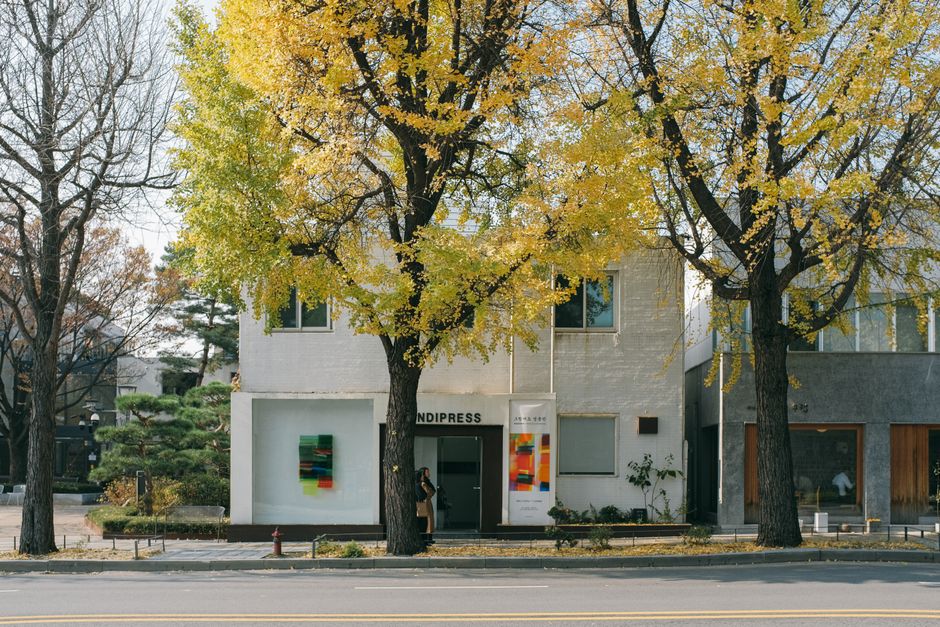
Walking east along Apgujeong-ro, the boulevard widens and the flagships appear — Gentle Monster's mothership on the south side, the Hyundai Card Music Library on the north, the Maison Boucheron at the corner, and the Comme des Garçons street-level showcase a block further east. The pace here is slower than one expects; the avenue is tree-lined, the pavements are wide, and the doormen at the flagships are unhurried. Each flagship is, in its own way, an architectural commission — the Gentle Monster room runs a rotating installation programme every six months, and the Hyundai Card library is a Frank Gehry-adjacent reading room with a printed-music archive of around 10,000 LPs. Entry is free at most flagships; a small admission applies at the Hyundai libraries for non-members. The reading is not retail; it is the architectural register itself, and the walk between rooms — five minutes, perhaps seven — is the considered version of a Causeway Bay afternoon. For the parallel architectural tradition further north, the Hannam detour piece reads the galleries and flagships on the other side of the Han River.

The Cheongdam galleries — the considered detour
A short northward turn off Apgujeong-ro brings one to the Cheongdam gallery cluster — a quiet line of small contemporary art rooms running between the boulevard and the Cheongdam-dong residential blocks. The cluster holds, on a given week, four or five active exhibitions; the rooms are small, the shows are short — three or four weeks — and the curatorial register is calm and unhurried. Admission is almost always free; a few rooms accept a small donation. The galleries' opening hours run, broadly, eleven to seven, with Mondays closed and a quieter Tuesday afternoon. One reads each room in twenty minutes and the cluster as a whole in just over an hour. The Tatler Asia art writers cover the Cheongdam scene with some attention; the cluster reads as a smaller, slower, more residential version of the Pedder Building. For the broader museum picture across Gangnam, the quiet museum circuit gathers six galleries off the tourist map.
Lunch — or rather, the late afternoon plate
By the third hour, a slow afternoon needs a small plate. The Apgujeong block holds two registers for this — a tasting-menu register, with chef-led modern Korean rooms one books a week in advance, and a lighter register of bakery cafés, sandwich rooms, and small bistros one can walk into. The lighter register is the right choice for an afternoon walking itinerary; a heavier seated lunch is better placed in the Gangnam tasting menu guide as its own appointment. The bakeries here run unusually well — laminated pastries, sourdough, the Korean soboro-ppang — and the bistros lean French-Korean and Italian-Korean with prices between KRW 18,000 and KRW 35,000 for a single plate. Cards close the bill; tipping is not expected. A small espresso at the end of the plate is the right pacing before continuing east. The Cheongdam tea houses — for those preferring a quieter, alcohol-free pause — are gathered in our tea houses edit.
The Rodeo block — late afternoon to early evening
Continuing east along Apgujeong-ro, the boulevard tightens into the Rodeo block — the small, dense, K-fashion-forward stretch that runs roughly between Galleria Department Store East and the Cheongdam-dong border. The Rodeo register is younger than the western flagship stretch — the brands are smaller, the storefronts are quicker to turn over, and the K-pop landmark cafés are scattered along the cross-streets. The afternoon route through Rodeo is a loop rather than a line — one walks the boulevard east, turns north onto Apgujeong Rodeo-gil, drops south at the next cross-street, and returns west along the parallel street one block south. The loop holds the highest density of independent boutiques in the quarter — Korean designers, vintage rooms, archival fashion — and the pace is brisk. For the K-pop landmark route specifically, the quiet K-pop landmark tour reads the SM and HYBE perimeters without crowding into the official meet-up culture.
An editor's hour — Galleria, the considered close
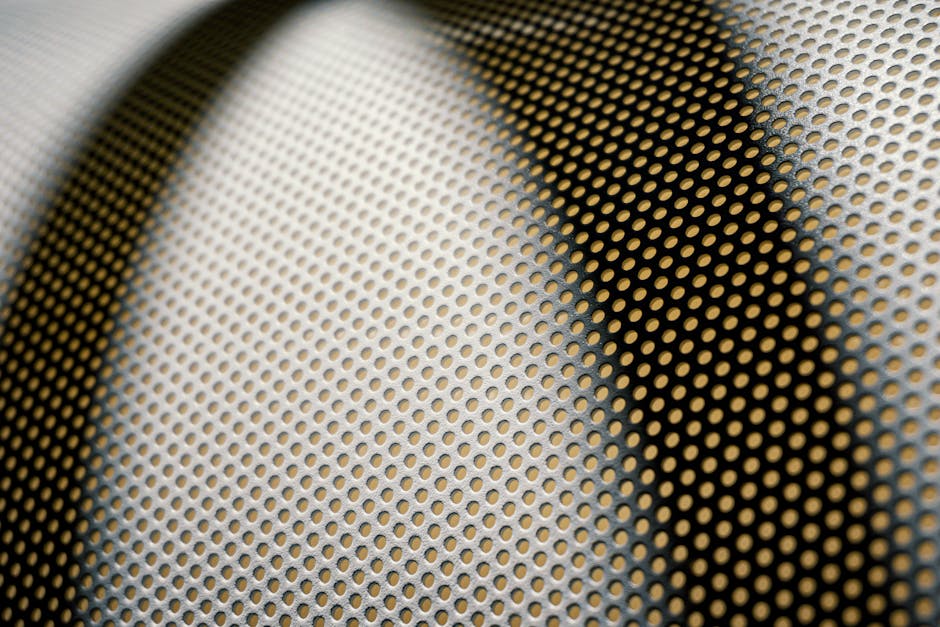
By five-thirty, the afternoon needs a close. The Galleria Department Store — twin buildings on the eastern edge of Apgujeong, the West building in dot-fabric mesh by UNStudio and the East building in raw concrete — is the considered answer. The Galleria is a Bulgari-tier department store with a calm grocery hall in the basement, a small art programme rotating through the building, and a series of quiet rooftop and high-floor reading rooms one can hold for an hour without ordering. The lower-ground food hall — Galleria Gourmet — holds the best Cheongdam-side patisserie counter and a small wine bar that opens at four. The pace at this hour matches the pace of the morning departure; the day reads as a single continuous afternoon rather than a sequence of stops. For the broader department-store reading across Gangnam, the Shinsegae and Galleria comparative piece holds the full comparison.
Return — taxi, Line 3, or the slow walk back
The return route from the Rodeo block to one's hotel — Sinsa, Yeoksam, or Samseong, broadly — has three considered options. A Kakao T or UT taxi from Apgujeong Rodeo to Sinsa runs KRW 4,500-6,500 and arrives within three minutes; the app reads in English and accepts foreign cards. Line 3 from Apgujeong Rodeo or Apgujeong station covers the same distance underground in seven minutes for KRW 1,500. The slow walk — Apgujeong Rodeo back along Apgujeong-ro to Sinsa station — runs thirty-five minutes at the afternoon's same considered pace, and is the right reading for the day's close. The Korea Tourism Organization keeps a useful primer on Apgujeong walking routes; their entry on the quarter is a worthwhile pre-read on the flight. Hong Kong friends arriving with two days in Gangnam often pair this itinerary with the seven-day wellness itinerary — the Apgujeong afternoon sits comfortably on day two or day three of the longer pacing.
Frequently asked questions
How long does the Apgujeong Rodeo walking itinerary take end to end?
A slow, considered version of the route runs around four hours — Dosan Park departure at one in the afternoon, Galleria close at five-thirty. A faster version compresses the same sequence into two-and-a-half hours by skipping the Cheongdam gallery detour and the lighter lunch. The pace is intentionally slow; the afternoon does not reward rushing.
What is the closest subway station to Dosan Park?
Sinsa station, Line 3 exit 5, sits a two-minute walk from the western edge of Dosan Park. Apgujeong station — also Line 3, exit 5 — is a slightly longer ten-minute walk from the eastern edge. Apgujeong Rodeo station on the Suin-Bundang Line covers the eastern end of the itinerary; the underground transfer between the two lines runs around five minutes.
Are the Cheongdam galleries free to visit?
Almost all of the small Cheongdam galleries run free admission, with the occasional small voluntary donation of KRW 5,000-10,000 for special exhibitions. Opening hours run broadly eleven to seven on weekdays, with Mondays closed and shorter Saturday afternoons. A polite walk-in is the convention; reservations are unusual for the smaller rooms.
What should I wear for the Apgujeong walking afternoon?
Apgujeong reads slightly more formally than the rest of Seoul — the flagships, the galleries, and the hotel lounges sit at a Mandarin Oriental register rather than a casual one. A light jacket, comfortable closed shoes, and a neutral palette read appropriately at every stop on the route. Trainers are accepted at the flagships and bistros but are quietly out of place at the Galleria upper floors.
Can I do the Apgujeong itinerary on a rainy day?
The route works on a rainy afternoon with two small adjustments. Replace the tree-lined Apgujeong-ro walking stretches with short Line 3 hops between Sinsa and Apgujeong Rodeo, and weight the indoor stops — the Hyundai Card library, the Cheongdam galleries, the Galleria upper floors — more heavily. The full sequence still reads as a single afternoon. The rainy-season indoor itinerary piece covers the broader monsoon strategy.
Do I need to book any of the stops in advance?
The flagships and galleries accept walk-ins without exception. The chef-led modern Korean rooms in the tasting-menu register require a one-week reservation and are not part of the lighter walking itinerary. The Galleria upper-floor reading rooms are open to all guests; no reservation required. A small handful of pour-over rooms in Cheongdam may take a same-day Naver Map enquiry for a competition-grade cup.
Is the Apgujeong route comfortable for solo travellers?
The Apgujeong quarter reads as one of the calmest and most solo-friendly districts in Gangnam — the cafés, galleries, and lounges welcome single guests without comment, and the avenue itself is unhurried. The Galleria upper-floor reading rooms, the Hyundai Card library, and the Cheongdam gallery cluster are particularly comfortable for an afternoon alone with a book. Our quiet corners piece gathers the same register for a longer stay.
How does Apgujeong compare to Hong Kong's Mid-Levels?
Apgujeong reads vertically, residentially, and slightly more architecturally than Mid-Levels — the flagships are commissioned rather than fitted, the galleries are quieter, and the pace is intentionally slower than the Star Street register. Hong Kong's Mid-Levels has a similar reading — quiet residential at the perimeter, denser commerce at the centre — but Apgujeong sits lower, wider, and more tree-lined. The two reward the same patience.